
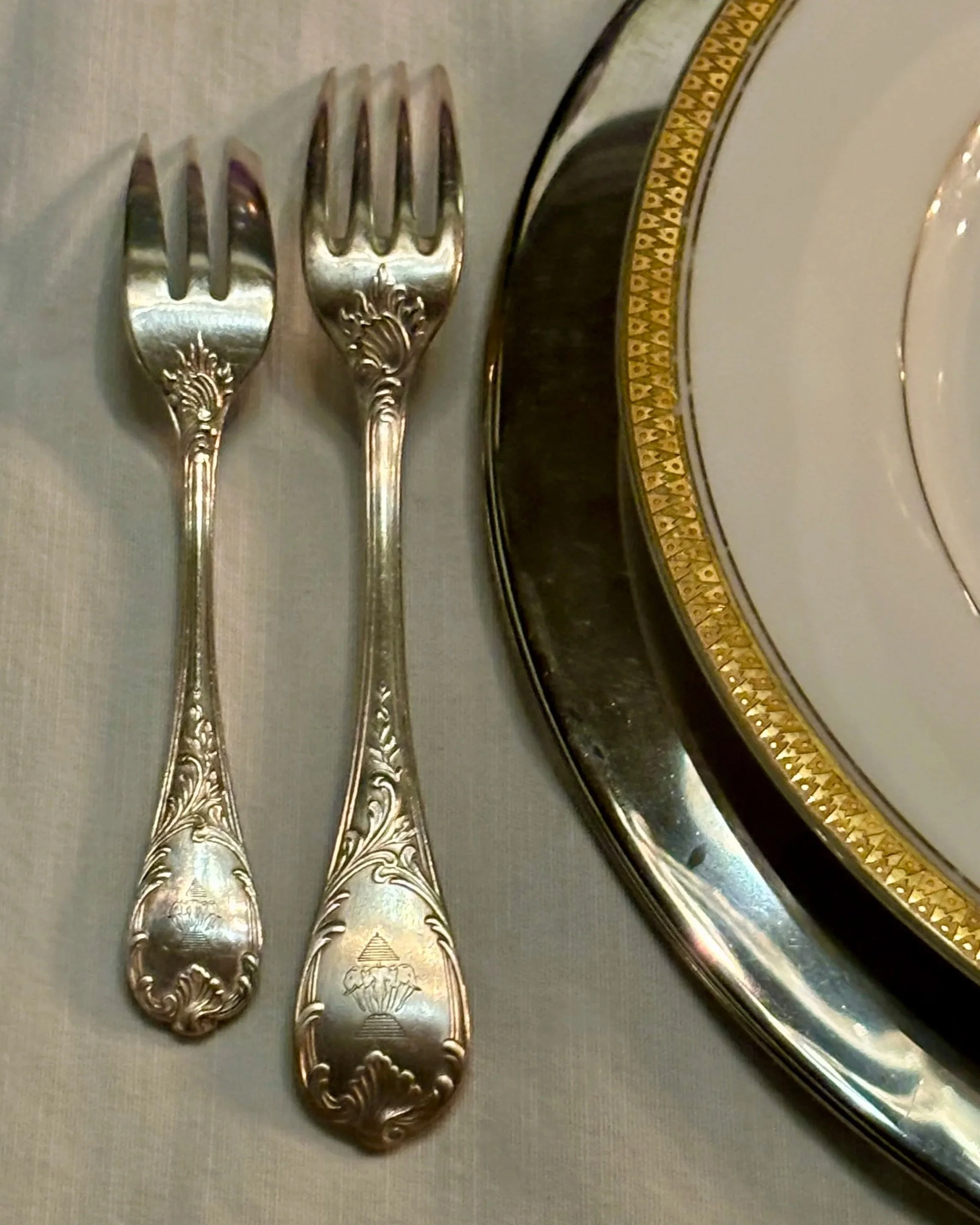
A silent cipher: French silver-plated Christofle forks in the Louis XV-style Marly pattern, engraved with the Royal Lao emblem, laid beside the pierced gilt border of a Noritake Goldridge plate in Vientiane today.
In a quiet neighbourhood café in Vientiane, a customer stirs an iced coffee with a heavy, tarnished spoon. Turn the handle over, and beneath the dull patina emerges the unmistakable silhouette of Erawan—the three-headed elephant sheltered beneath a tiered royal parasol. In the Lao capital, the twentieth century does not always reside in state archives; sometimes, it sits unnoticed in a cutlery drawer.
When the Kingdom of Laos emerged into full territorial sovereignty between the Franco-Lao Treaty of 1953 and the Geneva Accords of 1954—reclaiming statehood for the first time since the fragmentation of the ancient Kingdom of Lan Xang over two centuries earlier—the young nation suddenly required the full choreography of modern diplomacy. Heads of state had to be received in Luang Prabang and Vientiane; embassies had to be opened in Paris, London, and Tokyo. Alongside official motorcades and state protocol came urgent commissions to the great manufactories of Europe and Japan: bespoke porcelain and silverware designed to announce a sovereign kingdom at the dinner table.
Barely two decades later, history turned again. After the 1975 revolution transformed the kingdom into a Marxist-Leninist republic, those ceremonial appointments entered a strange, subterranean afterlife—absorbed by a new state, dispersed into private hands, or stripped of their heraldic memory.
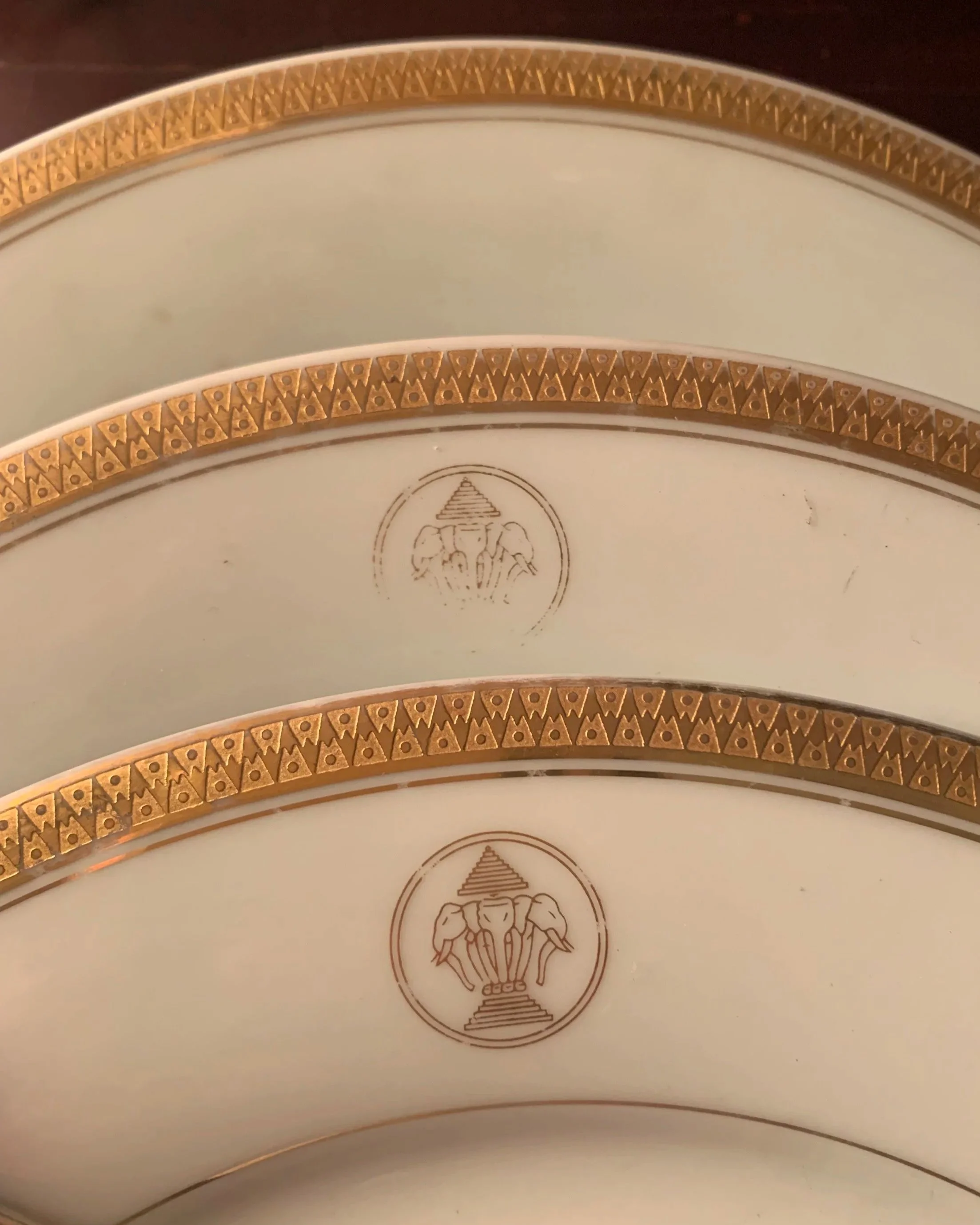
Three degrees of erasure: Stacked Noritake Goldridge porcelain plates, originally commissioned for Royal Lao diplomatic missions in the 1950s, reveal the triple-headed elephant Erawan beneath its tiered parasol intact (bottom), partially abraded (centre), and almost entirely sanded away after 1975 (top).
Nowhere is this tug-of-war between ideology and survival more legible than on the surface of a porcelain plate. Among the extant pieces of the Royal Palace service—English bone china made by Wedgwood in the gilded Whitehall pattern, introduced in the late 1950s—many bear a telling physical scar. Where the royal emblem once gleamed at the rim, the glaze is dull and abraded. Inherited by the successor state for official banquets, the plates were scrubbed with abrasives to erase the crest of the ancien régime. Practicality triumphed over iconography: the porcelain remained in state service; only its royal lineage was sanded away.
A similar fate befell the Japanese Noritake Goldridge porcelain—a pattern launched in 1953, the very year of independence—originally commissioned for the Ministry of Foreign Affairs and Royal Lao embassies abroad. Across Vientiane’s small network of antique stalls and family sideboards, these pieces circulate with a quiet, unhurried anonymity, often valued more for their durability than their provenance. When a trusted local brocanteur once presented a stack of twelve plates, four pristine examples with intact gilded emblems were placed neatly on top, concealing eight abraded ones beneath. Pointing out the sleight of hand provoked no rancour—only a shared, knowing smile. If the sanded plates had lost a fraction of their ornament, they had gained an unmistakable political weight. Remarkably, for all the upheaval they have endured, almost none are chipped or scarred by knife marks; only the gilt borders have softened gently with decades of handling.
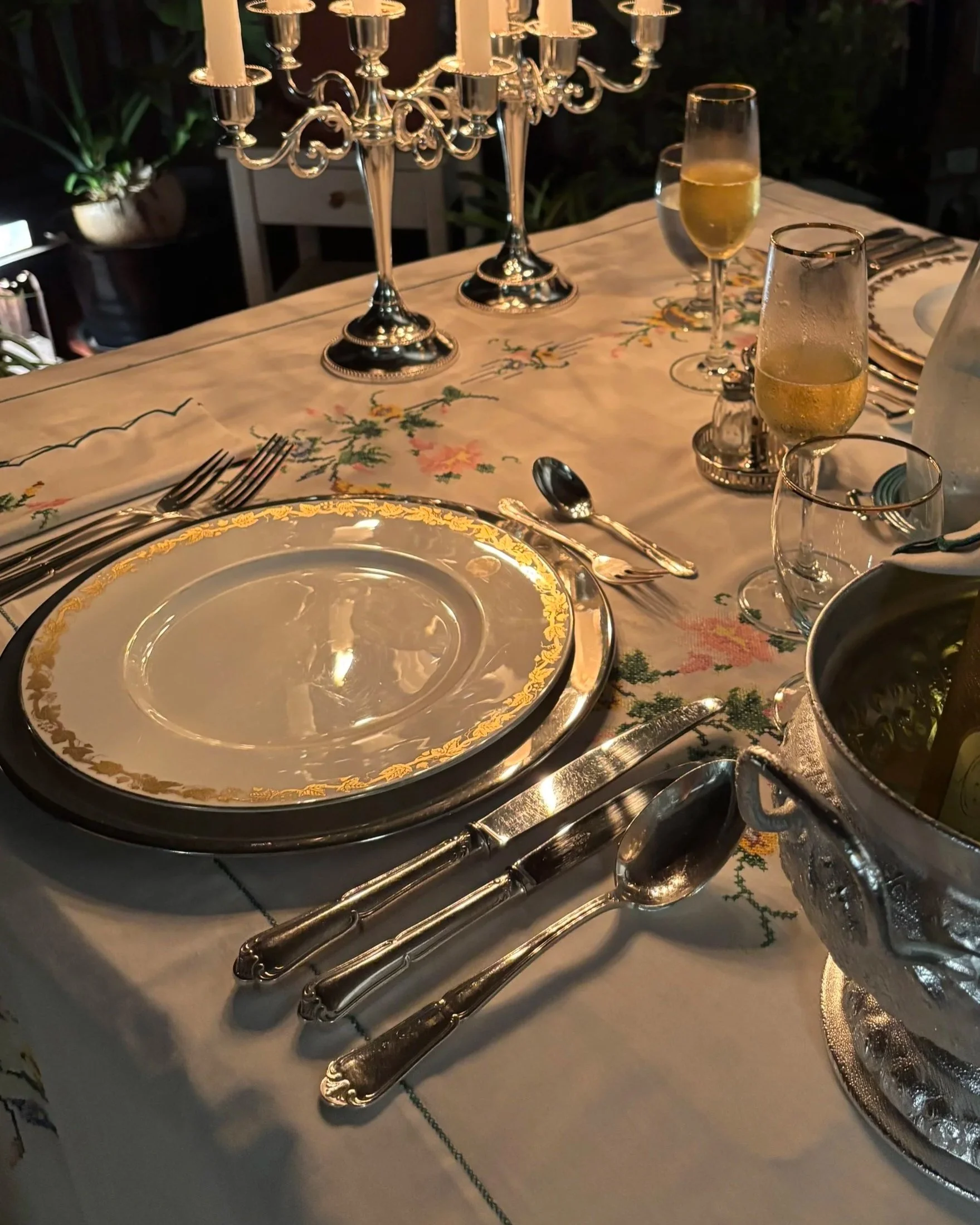
History pulls up a chair: Set on a Vientiane veranda by candlelight, rescued crested Wedgwood Whitehall porcelain from the Royal Palace and Louis XVI silver return to living service against the tropical night.
The accompanying silver followed an even more picaresque diaspora. Following 1975, pieces from the French silver-plated Christofle services—crafted in the Louis XV-style Marly pattern and engraved with the royal cipher for Lao diplomatic residences—were sold off piecemeal to raise cash. Today, a stray fork or soup spoon might turn up at a Sunday market, in a family kitchen, or at the Vientiane café where that first tarnished spoon came to light. When asked if the rest of the cutlery drawer might be inspected, the bemused owner graciously emptied the assortment onto the wooden counter, allowing a handful of stray royal pieces to be redeemed on the spot—rescued from obscurity, though never quite stripped of their working life.
To lay these objects out in Vientiane today is to stage an affectionate dialogue between mid-century formality and the tropics. The Mekong’s humidity blackens silver at remarkable speed, demanding a patient afternoon polish before evening; yet once the candles are lit, the table recovers a forgotten poise.
For all their historical weight, such pieces resist the stillness of museum glass. Material culture ceases to be culture the moment it is forbidden to live. Around a dark Lao hardwood table at dinner, no provenance needs to be announced beforehand. Inevitably, halfway through the meal, a guest turns over a heavy Marly fork or catches the half-erased emblem on the rim of a plate—and the conversation begins on its own. Beneath evening candlelight, sanded crests and rescued silver cease to be ghosts: they become living witnesses to a city where history is still allowed to pull up a chair.