
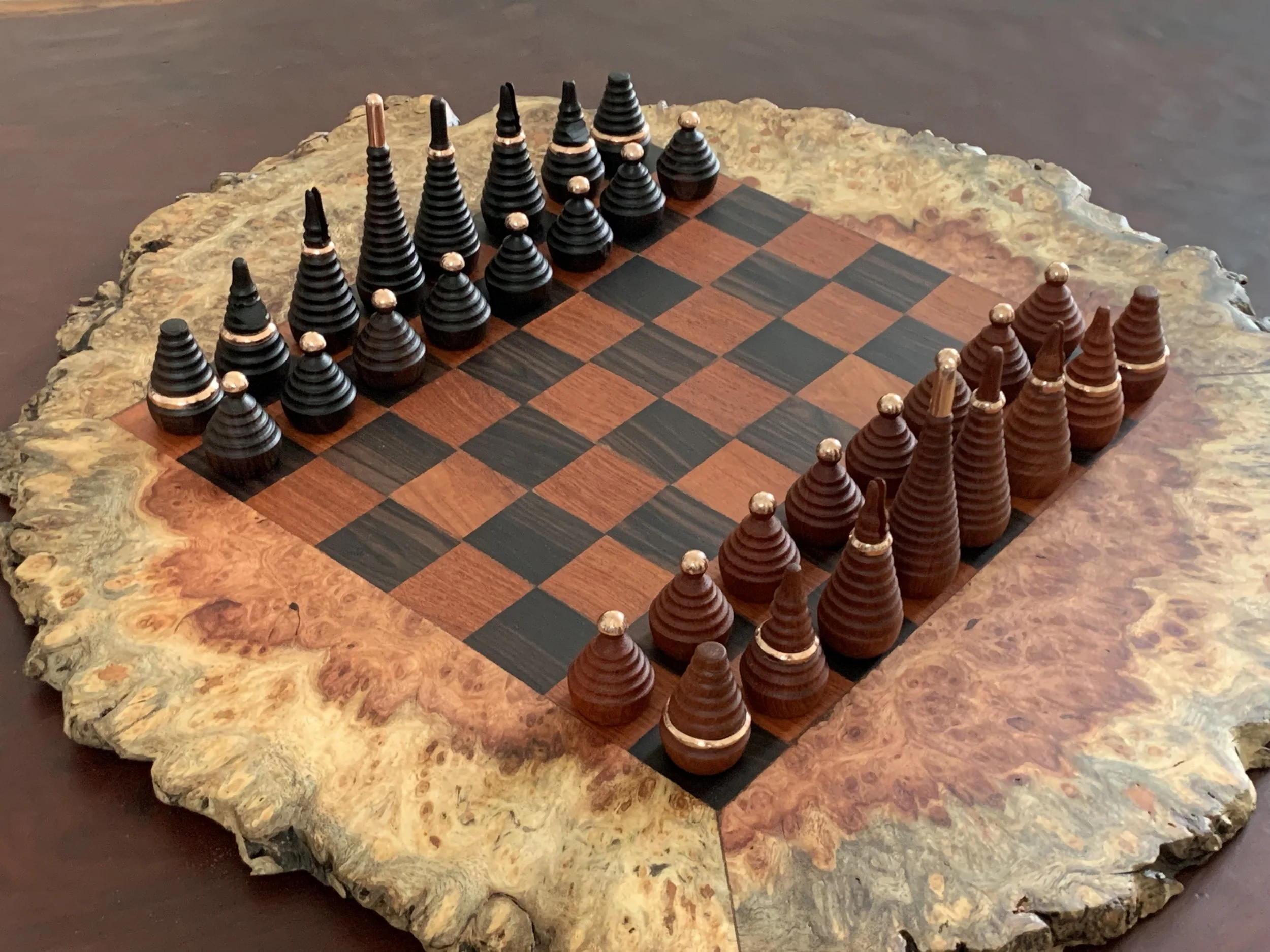
The That Dam Chessboard (2023): sixty-four squares of crimson mai dou (padauk) and black mai moun (ebony) inlaid into a five-millimetre live-edge slab of rosewood burl (mai saw), with stepped stupa pieces finished in hand-burnished pure silver. Private collection, Shanghai.
Among domestic objects, a chessboard occupies a singular position. Unlike a vase or a box, it is never merely looked at; it invites touch, weight, and the slow choreography of the hand. Yet even when no game is in progress, it remains on a table as a piece of miniature architecture—a quiet landscape of contrasting grains, shadows, and proportions.
The seed for the two chessboards I designed in Vientiane was planted in 2022, just as I was preparing to join Sandra S. Yuck as her successor at the creative helm of her storied atelier, Caruso. Around that time, a client from India approached the studio requesting a bespoke chess set with figuratively carved pieces: miniature royal busts of bride and groom on pedestals for the kings and queens, and sixteen elephants carved in Luang Prabang in eight distinct postures for the pawns. When we calculated the months of hand-carving required, the commission proved prohibitively complex and costly, and had to be set aside. Yet Sandra—a woman of rare discernment and old-world British-Hong Kong poise, whose eye shaped so much of my thinking in Laos—kept gently insisting that the idea should not be abandoned, reminding me that sooner or later I owed the studio a chessboard of my own.
Between 2023 and 2024, I finally answered her prompt—though by turning away from figurative sculpture toward pure geometry and woodturning. Doing so meant asking a workshop renowned for ultra-fine, featherlight vessels to venture into unfamiliar territory. For three decades, these master craftsmen had perfected the art of turning dense tropical hardwoods into porcelain-thin, delicately balanced forms; yet working on a flat plane just five millimetres thick—where sixty-four individual hardwood squares are held together solely by precision-angled joints and the surrounding burl frame, without any heavy structural backing—was something they had never attempted. In Laos, where the monsoon alternates between saturating humidity and parching heat, flat timber moves relentlessly; the artisans were understandably sceptical that boards cut so slenderly would hold their tension without warping or opening along the seams.
Pushing past that resistance became the real subject of both pieces.
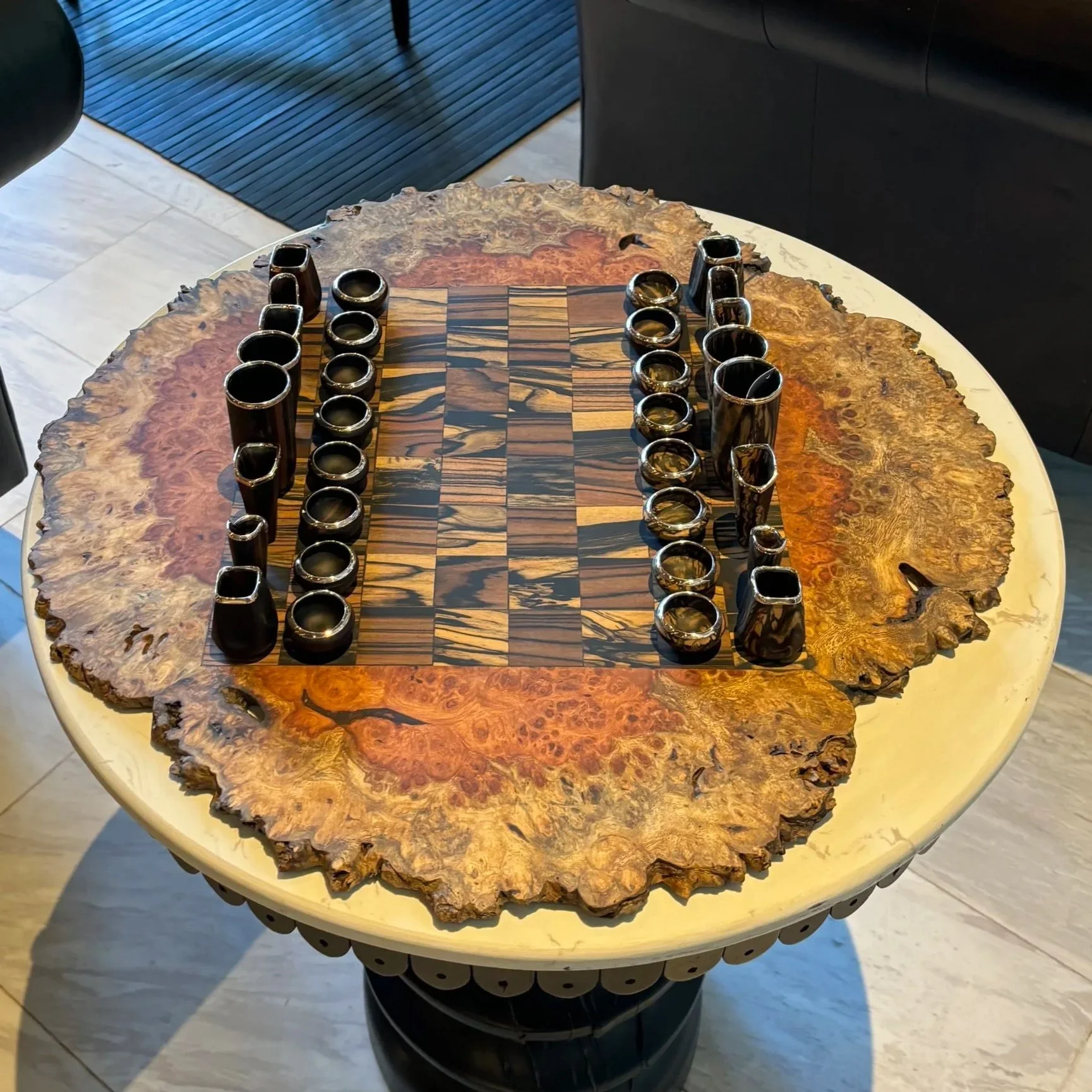
The Vessel Chessboard (2024): diagonal squares of striped black-and-white ebony set within a thin rosewood burl disc, paired with thirty-two miniature turned vessels from the studio’s repertoire. Exhibited at the inauguration of the Lao Traditional Silk Residence, Vientiane; private collection, Shanghai.
The first board—conceived as a quiet tribute to That Dam, Vientiane’s moss-darkened stupa, and to the sacred reliquaries scattered across the Lao landscape—paired a grid of crimson mai dou (padauk) and river-black mai moun (ebony) within a slab of figured rosewood burl (mai saw), its organic, bark-lined perimeter left intact. Rather than carving conventional knights and bishops, we turned all thirty-two pieces on the lathe as stepped, conical stupas. Each spire was then passed from the woodshop to the silversmiths’ bench, where thin bands and finials of pure silver were hand-fitted and burnished into the dark and red timber—catching the light like temple spires after rain. To make the game immediately legible in play, the pieces ascend in both height and silver placement according to rank: squat pawns crowned only with a tiny silver finial at the apex; rooks anchored by a silver band at the base; knights and bishops rising progressively higher with silver rings climbing their stepped profiles—distinguished further by an angled, jaw-like cut on the knight and a traditional mitre-like vertical cleft on the bishop; the queen wearing a silver collar just beneath her spire; and the king topped with a tall, solid-silver finial.
The second board, completed in 2024, took a more playful, almost architectural turn. Instead of sacred monuments, the thirty-two pieces were conceived as a miniature anthology of the studio’s most recognizable turned vessels—hollowed silhouettes in striped black-and-white ebony, scaled down to fit the palm of a hand. Here too, scale and silhouette govern the hierarchy: low, rounded bowls for the pawns; squared-off vessels for the rooks; stepped, two-tiered mouths on the knights evoking an horse’s saddle; flared, bouquet-mouthed Art Deco forms for the bishops; and two towering vases at the centre—a slender, V-profiled vessel for the queen beside a broader, U-shaped form for the king. Beneath them, the playing field itself became a study in visual tension: sixty-four squares of pale-and-charcoal striped ebony set diagonally into a thin disc of fiery rosewood burl, where the wild, swirling grain of the root collides with the strict geometry of the grid.
Watching the artisans move from doubt to quiet triumph as both boards held their flatness—and their precision—was among the most rewarding experiences of my time at Caruso. Before entering private collections in Shanghai, the two sets were exhibited in both Vientiane and Luang Prabang, with the vessel-inspired board later presented at the inauguration of the Lao Traditional Silk Residence, the newly established cultural institution set within the grounds of Hor Kham, the Presidential Palace.
Today, looking back at both boards, I think first of Sandra’s quiet encouragement—and of the proof that even the most refined tradition stays alive only when it is gently provoked, asked to translate thirty years of mastery into an unfamiliar geometry and discover what the wood will allow.