
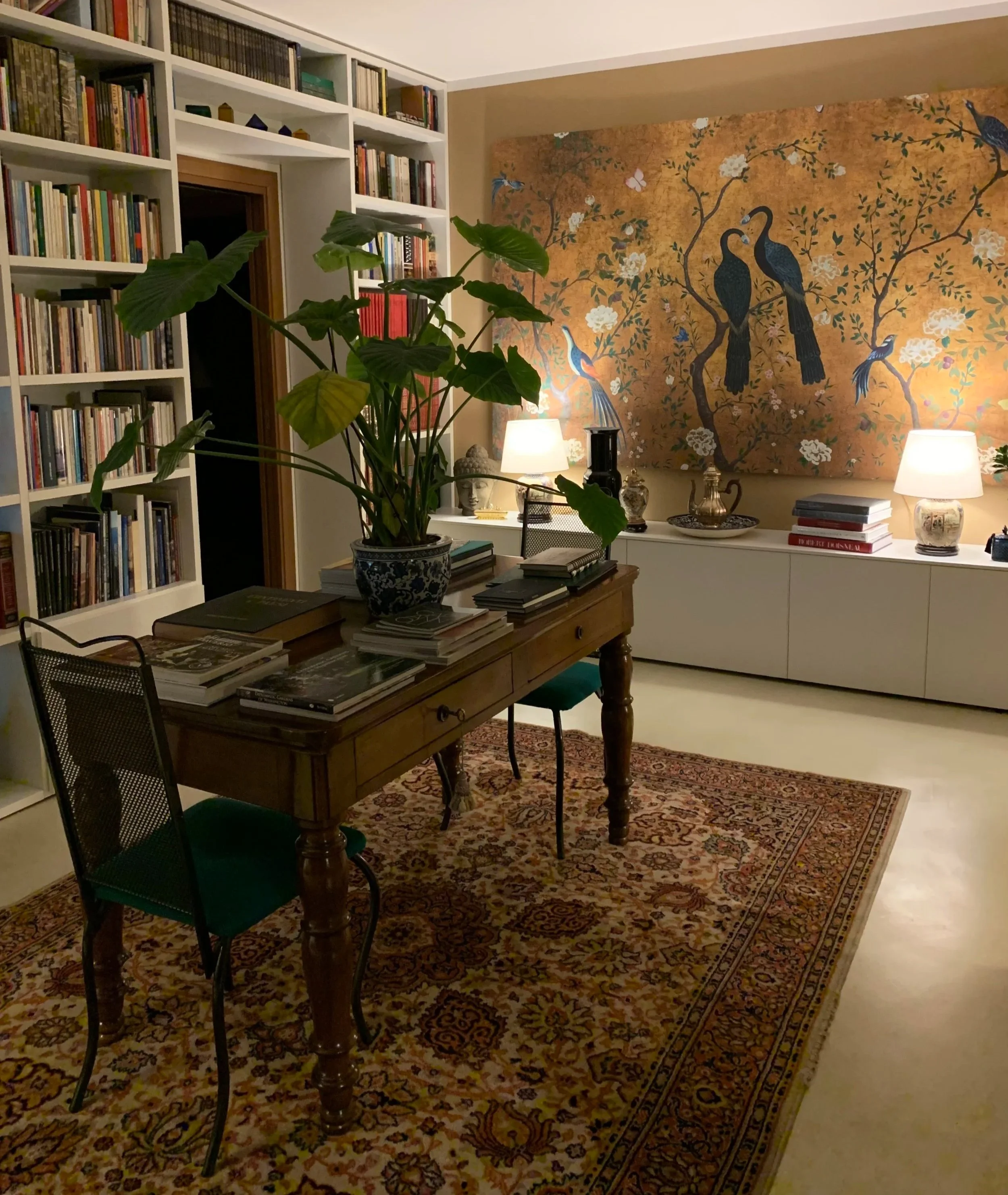
In Brescia, a gilt-ground panel of peacocks rests against sand-toned lime plaster and pale poured-resin floors, anchored by an antique Lombard table stacked with books and contemporary chairs by Cattelan Italia – a modern shell softened by Asian resonance.
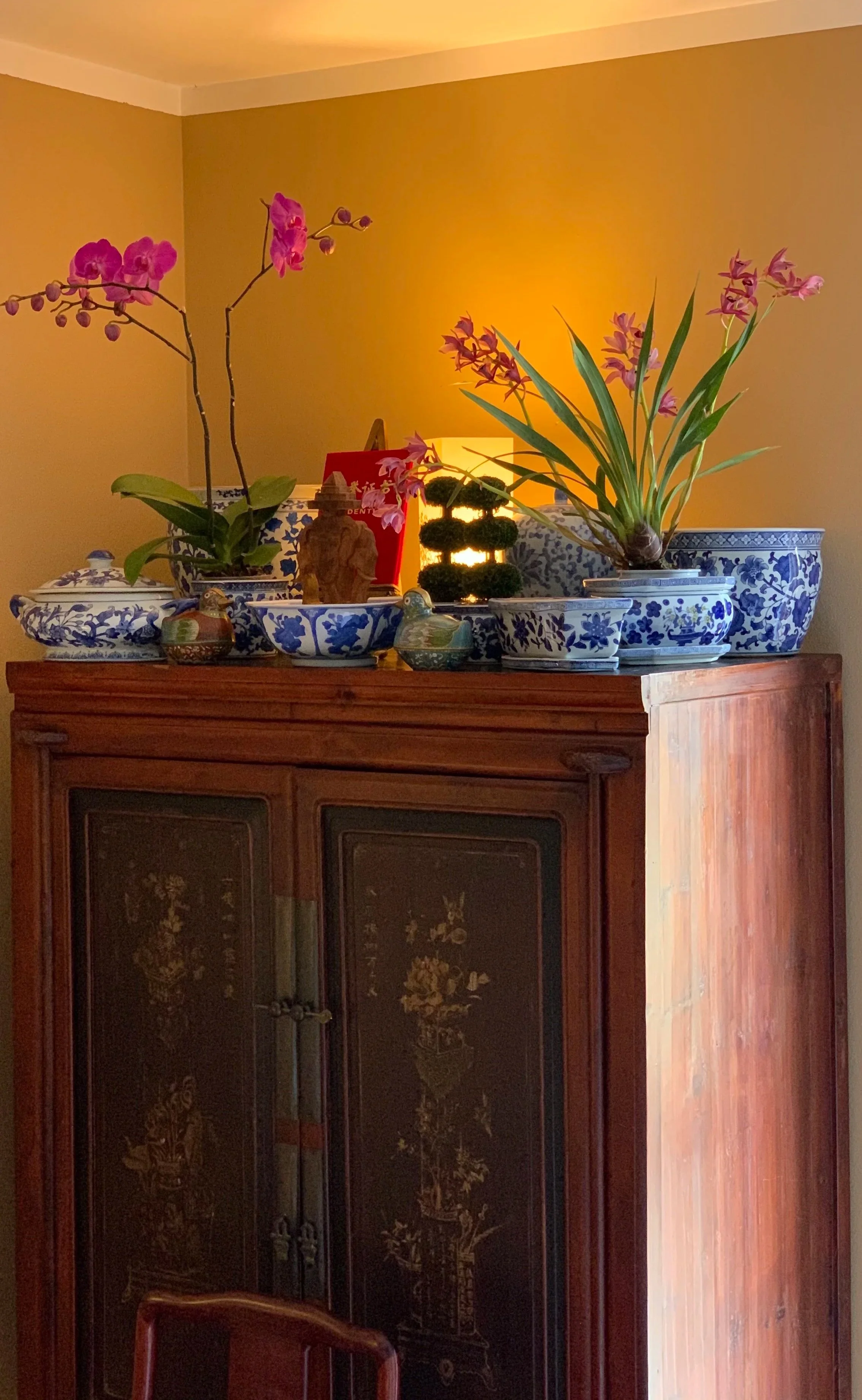
Atop a lacquered Chinese cabinet in Italy, orchids, export porcelain, cloisonné mandarin ducks, and a carved Lao wooden three-headed elephant gather into a self-contained landscape.
At fifteen, walking through the apartments of Fontainebleau, I was already unimpressed by royal scale. I had seen enough state rooms – from Palazzo Pitti to the Winter Palace, from Chantilly to Stupinigi – to know that imperial grandeur quickly becomes repetitive. What stopped me cold at Fontainebleau was a single anatomical detail: the face of a sphinx folded directly into the structure of an Empire armchair. That was the Retour d’Égypte at its sharpest – not an archaeological reconstruction, nor a theatrical costume, but the absorption of a foreign civilisation into a domestic object with which one actually lives, until the alien form acquires a pulse of its own.
Decades later, split between a flat in Brescia, Italy, and one in Vientiane, that early shock has hardened into a working principle I call Le Retour de Chine.
To define it, one must first state what it is not. It has nothing to do with chinoiserie. Between the seventeenth and nineteenth centuries – from the Royal Palace of Turin and Sanssouci to the Brighton Pavilion and the East Wing of Buckingham Palace – chinoiserie was a totalising Rococo and Baroque hallucination. It covered a room from plaster cornice to under-carpet in an imagined Cathay. As a totalising decorative language, historical chinoiserie belongs to its own century; what often clutters the market today is a diluted neo-chinoiserie – commercial pastiche reduced to predictable blue-and-white clichés.
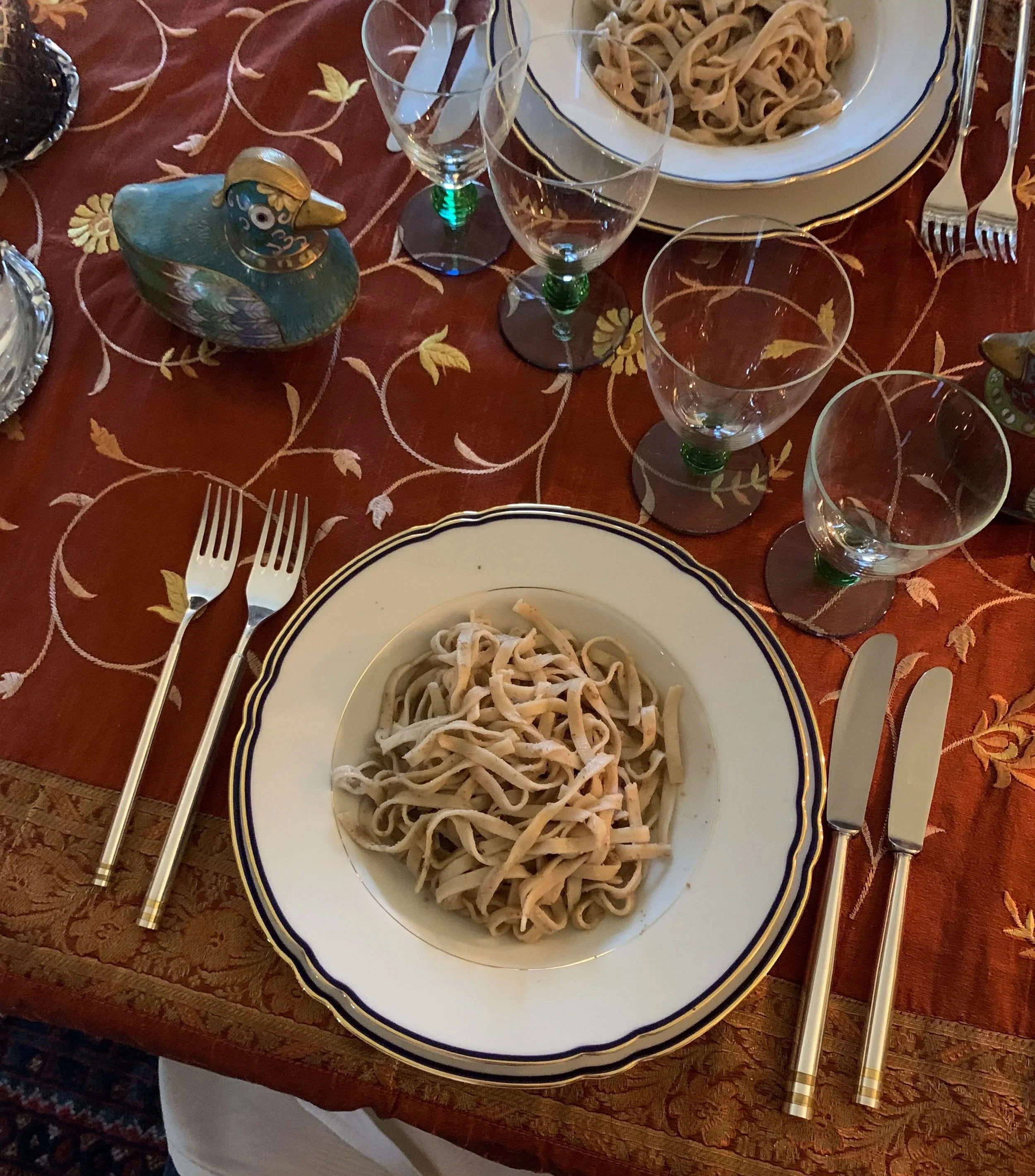
Ivory-ground Bavarian porcelain with cobalt-and-gilt rims by Seltmann Weiden, Murano glass by Vincenzo Nason, and Ricci silver flatware set over an antique rust-coloured cloth with metallic embroidery from Chiang Mai.
Le Retour de Chine belongs to the present, and it requires neither a palace nor period panelling. My flat in Italy is unapologetically contemporary: pale poured-resin floors, flush skirting boards, walls finished in sand-toned lime plaster. There is nothing remotely historical about the shell. Yet during the stillness of lockdown, observing the top of a lacquered Chinese cabinet where orchids, export porcelain, cloisonné mandarin ducks, and a carved Lao wooden figure had gradually gathered, I realised how naturally these fragments formed a self-contained world.
Unlike chinoiserie, which demands total immersion, Le Retour de Chine works by inflection. It is an aesthetic of travel, memory, and coexistence. In a room, an Asian form does not need to shout; it enters as a deliberate note alongside echoes of Indochine restraint and British Colonial poise. In Italy, it might be a gilt-ground panel of peacocks resting against bare lime plaster, or Bavarian gold-rimmed porcelain and Murano glass set over an antique rust-coloured cloth heavy with metallic embroidery. In Vientiane, it is a pagoda-form bed – half pavilion, half birdcage – acting as an architectural threshold against jungle wallpaper, or carved wooden stupas and chased silver boxes sharing a low table with European monographs and battered issues of The World of Interiors, shaped through ongoing dialogue with local cabinetmakers and artisans.
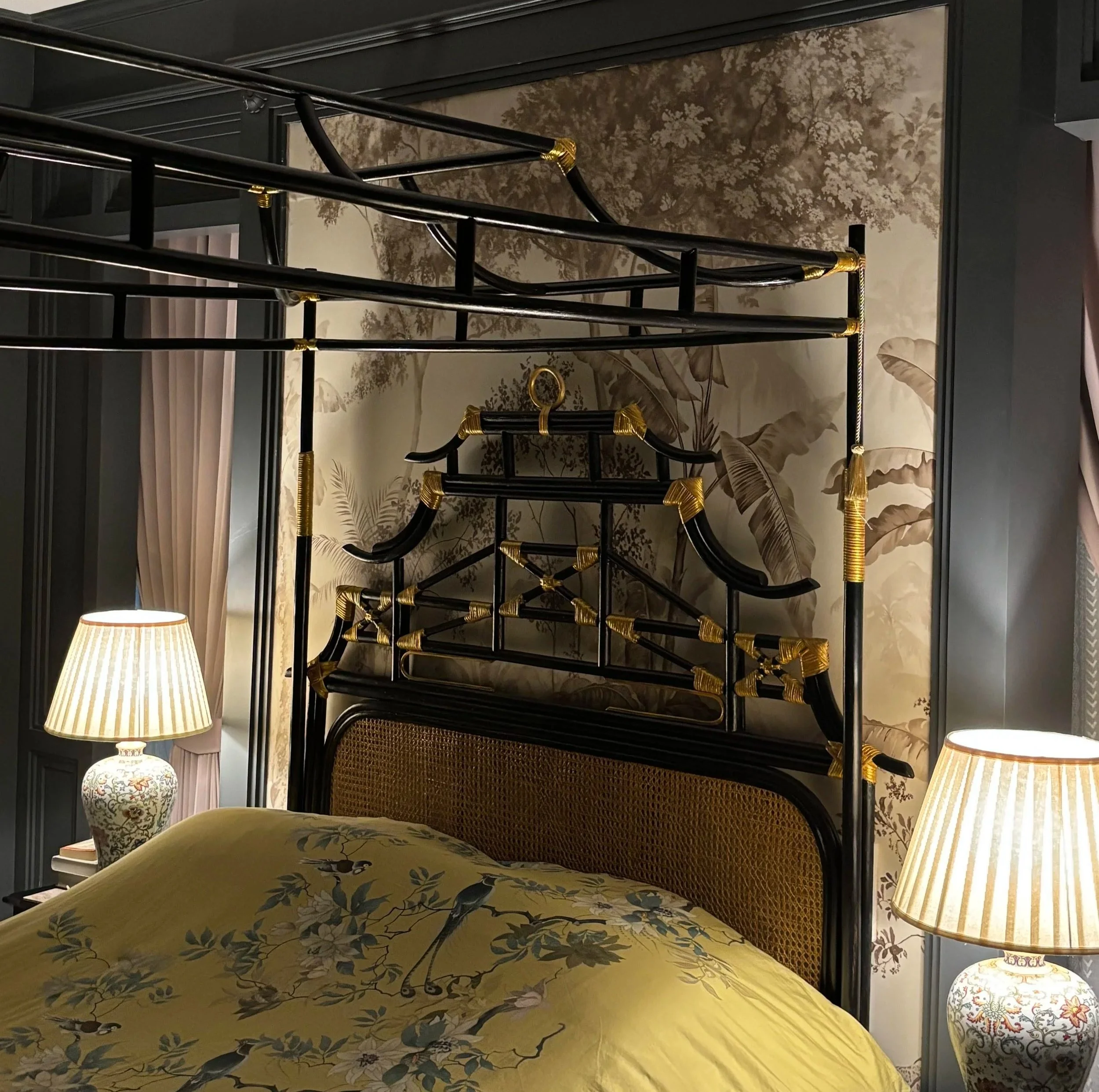
In Vientiane, a custom pagoda-form bed in black-lacquered rattan acts as an architectural threshold against jungle wallpaper and lead-grey panelling, flanked by Qianlong-style porcelain lamps and dressed in a mustard bedspread painted with birds and blossoms.
If there is a technical secret to making such disparate things cohere without turning a home into a curio shop, it comes before colour, before provenance, and before style: it is the distance between objects. Knowing how to measure the intervals – the exact proportion of empty air separating one piece from another – is the entire grammar of interior composition. Between the objects themselves, I have no interest in postmodern irony or deliberate visual friction. What holds them together is a quiet historical continuity, mostly rooted in the sensibility of the nineteenth and early twentieth centuries, tempered by silence.
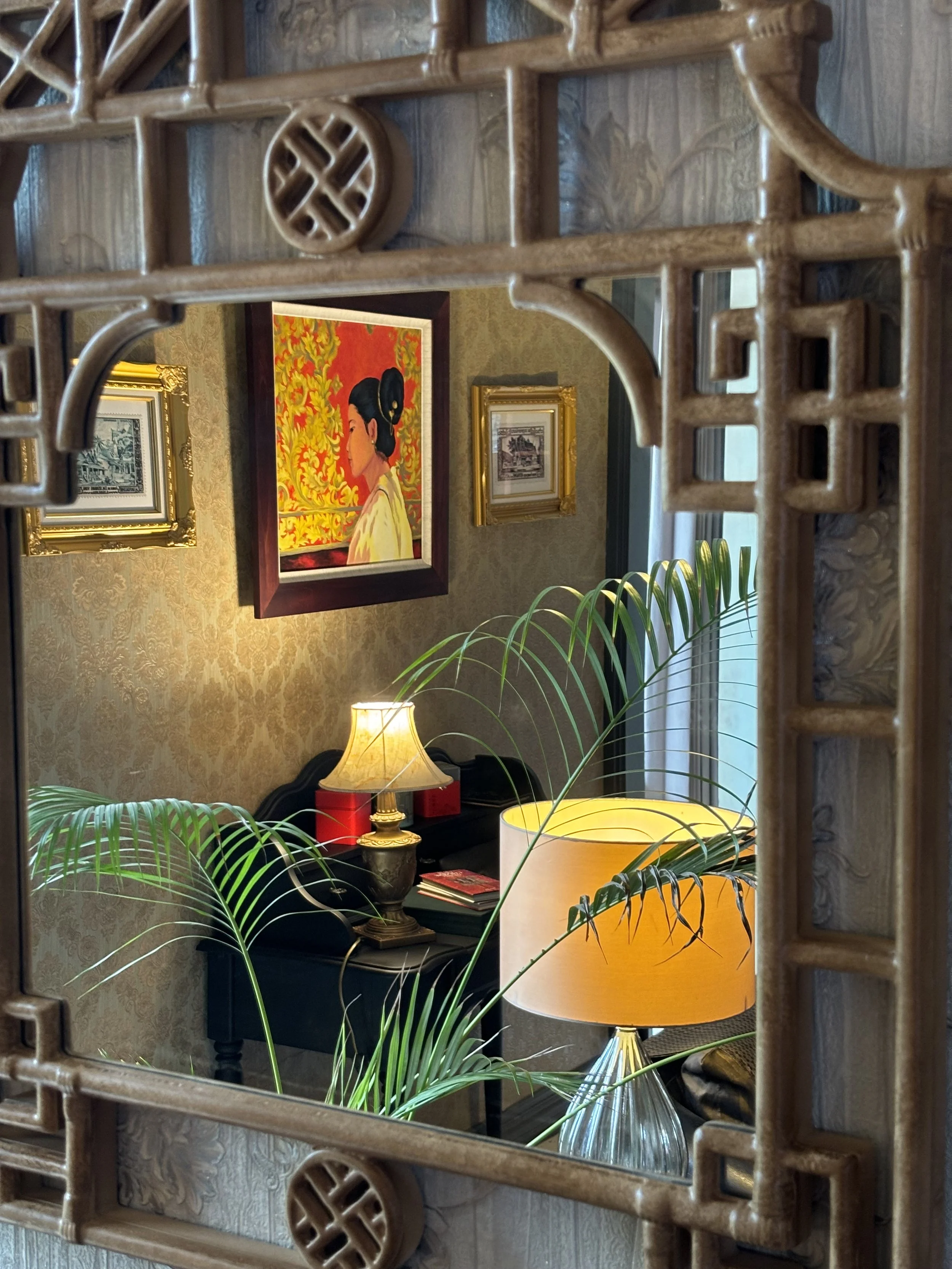
Reflected in a carved bamboo-motif mirror, a painting from the school of Marc Leguay, framed enlargements of early Lao postage stamps by the artist, warm lamplight, and tropical foliage compose a quiet interior geography.
A close friend of mine, Sara, who knew my Italian flat intimately before coming to visit me in Laos, summed it up better than any critic could: "Pietro, walking into your house in Italy or walking into your house here is the exact same experience." Rebuilding that sanctuary in Vientiane required patience and quiet obsession, precisely because these objects are not decoration; they are a portable geography. Brought under one roof, they cease to be Chinese, Japanese, Lao, or European. They become a personal lingua franca that prevents displacement, whether outside the window lies the dark silhouette of a cedar of Lebanon or the tropical heat of the Mekong.
Above all, a house built this way must reject the sterile perfection of the museum vitrine. My uncle, who ran an antique gallery and irreversibly formed my eye for objects, kept only half-burned candles in his candelabra. Brand-new, unlit tapers, he used to say with a smile, belong in shop windows, not in homes that are actually lived in. It was a lesson I never forgot. A blackened wick, a book left open at a chosen page, linen softened by decades of washing – these quiet signs of use are what give a room its soul without ever disturbing its order. A house should remain poised and immaculate, yet never sterile: not a stage set frozen for inspection, but a composed sanctuary where cultivated life is visibly at ease.