
From the ceremonial ateliers of the Royal Palace of Luang Prabang to signed contemporary commissions: an inquiry into the history, technical grammar, and intergenerational survival of Lao metallic-thread embroidery through the lineage of Ajahn Phatthana Bouavong and Manola Chittarath.
I. Courtly Origins and the Grammar of Relief
Within the textile heritage of Luang Prabang, Lao needlework (kan pak saeo) has historically been divided into two distinct technical traditions: flat silk embroidery (saeo pha) and high-relief metallic-thread embroidery (pak din). Whereas flat silk embroidery adorned domestic textiles and regional garments across northern Laos, pak din—literally "embroidery with metallic wire or bullion"—emerged as a specialised courtly discipline intimately bound to the ceremonial life of the Royal Palace of Luang Prabang (Phra Ratchawang Luang Prabang) and the city’s principal royal monasteries.
Unlike woven brocades (chok or khit), where metallic supplementary wefts are integrated directly on the loom, pak din is an additive, sculptural art form executed over an already woven ground. Built in high relief to catch both natural daylight and the warm flicker of temple candles, the technique codified social rank, dynastic authority, and Buddhist devotion across court dress—most notably ceremonial sinh skirts, structured jacket collars (kho suea), and shoulder cloths (pha biang)—as well as ecclesiastical banners and prestige palace cushions.
The resilience of this craft is all the more remarkable given the political ruptures of the nineteenth century. Following the Siamese military campaigns of 1826–1828 (B.E. 2369–2371), when large numbers of Lao artisans and court specialists were forcibly relocated from the Mekong valley, the workshops of Luang Prabang nevertheless succeeded in preserving their distinct iconographic vocabulary. Motifs continued to be drawn directly from the gilded stucco reliefs, lacquer doors, and mural programmes of Luang Prabang’s monastic complexes (vat), enshrining sacred emblems such as the fifteen-headed Naga (lai nak sip ha takun), mythical guardians from classical Lao literature, and the ceremonial gourd (lai nam tao).
II. Transcontinental Materials: From Pure Bullion to the Fil d’Or de Lyon
A defining characteristic of Luang Prabang court embroidery lies in its material cosmopolitanism. In the pre-colonial period, royal ateliers relied on pure gold and silver drawn and beaten into fine metallic filaments and spirals. With the establishment of the French Protectorate and the expansion of transcontinental trade networks across Indochina, master embroiderers in Luang Prabang integrated imported metallic bullions, twisted gilt threads (mai kham fan), and fine silks originating from Lyon and India.
For centuries, the passementerie and metallic-thread workshops of Lyon had supplied European courts and ecclesiastical vestment makers with canetille and silver-gilt bullions renowned for their tensile strength and warm lustre. Introduced into Laos alongside fine Indian woven silks, these French metallic threads were adopted by Luang Prabang masters not as a replacement for local aesthetics, but as a technical refinement. Paired with silk taffeta or rich woven grounds, Lyon metallic thread allowed artisans to achieve sharper sculptural definition and greater durability while remaining strictly governed by traditional Lao compositional rules.
III. Technical Discipline and the Freehand Standard
Executing a major work in pak din demands a level of patience and structural control that resists industrial acceleration. A complete ceremonial wedding ensemble, for instance, requires between three and five months of continuous work, while particularly intricate commissions can occupy an embroiderer for up to a full year.
The process unfolds through a rigorous sequence: stretching the ground silk onto a wooden frame, establishing the ornamental layout, building padded under-structures (thom din) to give three-dimensional volume to the motifs, and couching lengths of metallic bullion onto the surface with minute anchoring stitches. As practitioners in Luang Prabang emphasise, any haste or tension immediately betrays itself on the finished surface: if the hand is hurried, the metallic relief loses its fluidity and rhythmic grace.
Crucially, the highest Luang Prabang standard is distinguished by how the design is transferred onto the fabric. While some contemporary workshops rely on pre-cut stiffened paper or cloth templates (sab dok) that are appliquéd onto the ground cloth and then covered with thread, masters of the royal palace lineage adhere to direct freehand drafting (taem phang long pai thi pha loei). By drawing the entire composition directly onto the taut silk before laying a single stitch, the artist establishes the structural flow of the piece in a single, unrepeatable gesture—leaving virtually no margin for correction.
IV. Transmission and International Recognition: The Atelier of Ban Na Luang
In the late twentieth and early twenty-first centuries, the survival of pak din has depended on a small circle of master custodians committed to teaching the discipline outside commercial mass production.
In Luang Prabang, the foremost living authority of this lineage is Ajahn Phatthana Bouavong of Ban Na Luang, whose technical training descends directly from the court embroiderers who served the Royal Palace. Over decades of practice—and through open, tuition-free instruction offered to younger apprentices in her home atelier—Ajahn Phatthana has functioned as both a master maker and an informal academy. Her pedagogy begins with foundational geometric exercises, such as small triangular and quadrilateral motifs (na mon), before students progress to complex floral scrolls, jacket collars, and full ceremonial borders. Among the artisans trained in her workshop is Phetdaovone Philavanh of Ban Ma, who entered the atelier at the age of fifteen and has since achieved master-level proficiency, illustrating how the workshop sustains livelihoods while anchoring women and young artisans within their home communities.
The international standing of Ajahn Phatthana’s school has been affirmed on major museum and exhibition stages. Works produced by Ajahn Phatthana alongside her senior disciple and collaborator Khounphithak Ratisavath—whose Luang Prabang house Meun Na Pha Mai acts as an active link between local weavers, embroiderers, and formal patronage—are held in the collections of the Luang Prabang National Museum. Beyond Laos, their pieces have received international acclaim at the International Handicrafts Festival in Bukhara, Uzbekistan, winning third prize in 2022 and first prize in late 2025.
V. Contemporary Patronage: From Ceremonial Dress to Heraldic Architecture
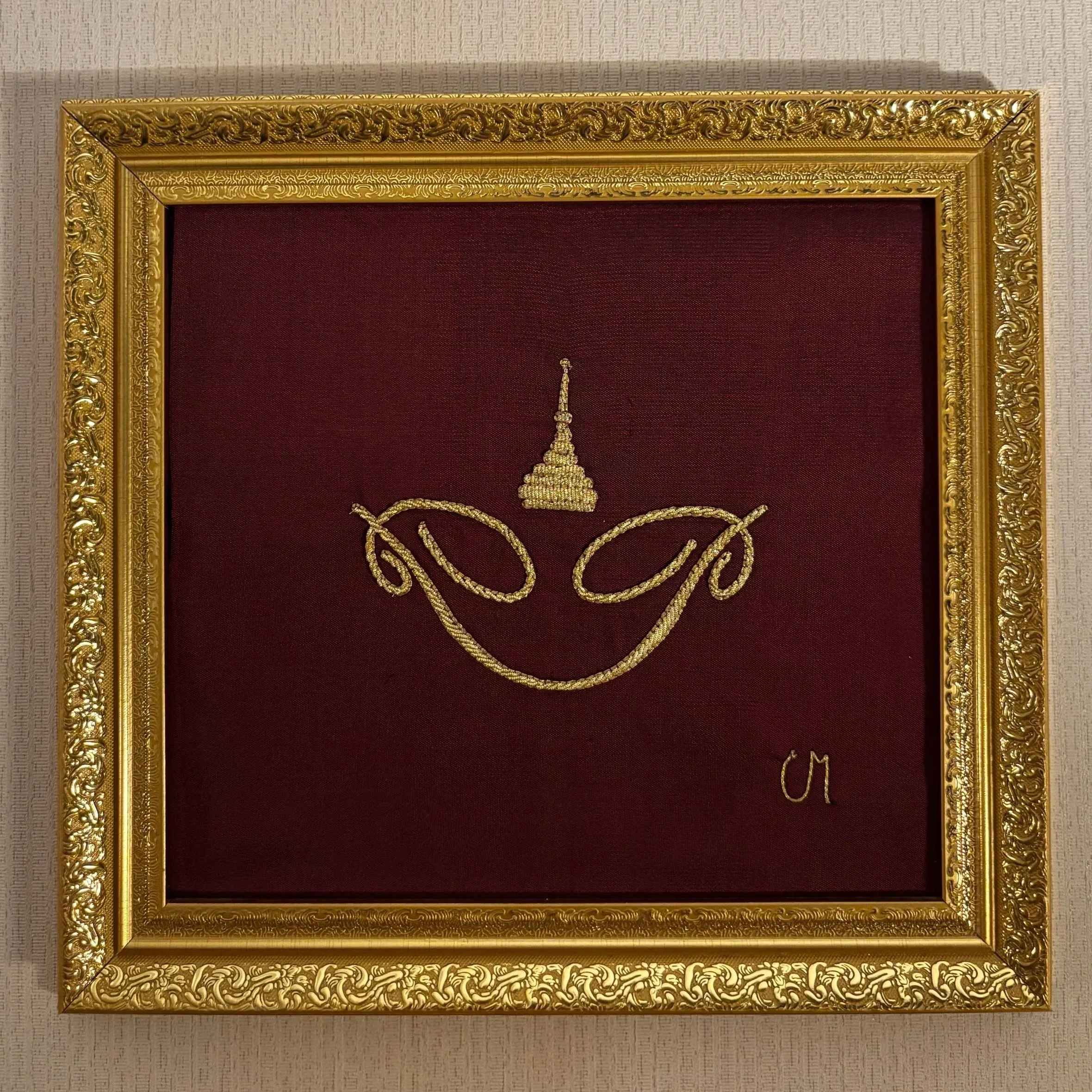
oint nuptial monogram (P & P) beneath a five-tiered Lao architectural finial (that), silver-gilt metallic bullion (fil d’or de Lyon) on claret silk taffeta, signed with the Lao consonant M (ມ), June 2025. Executed by Manola Chittarath, Luang Prabang.
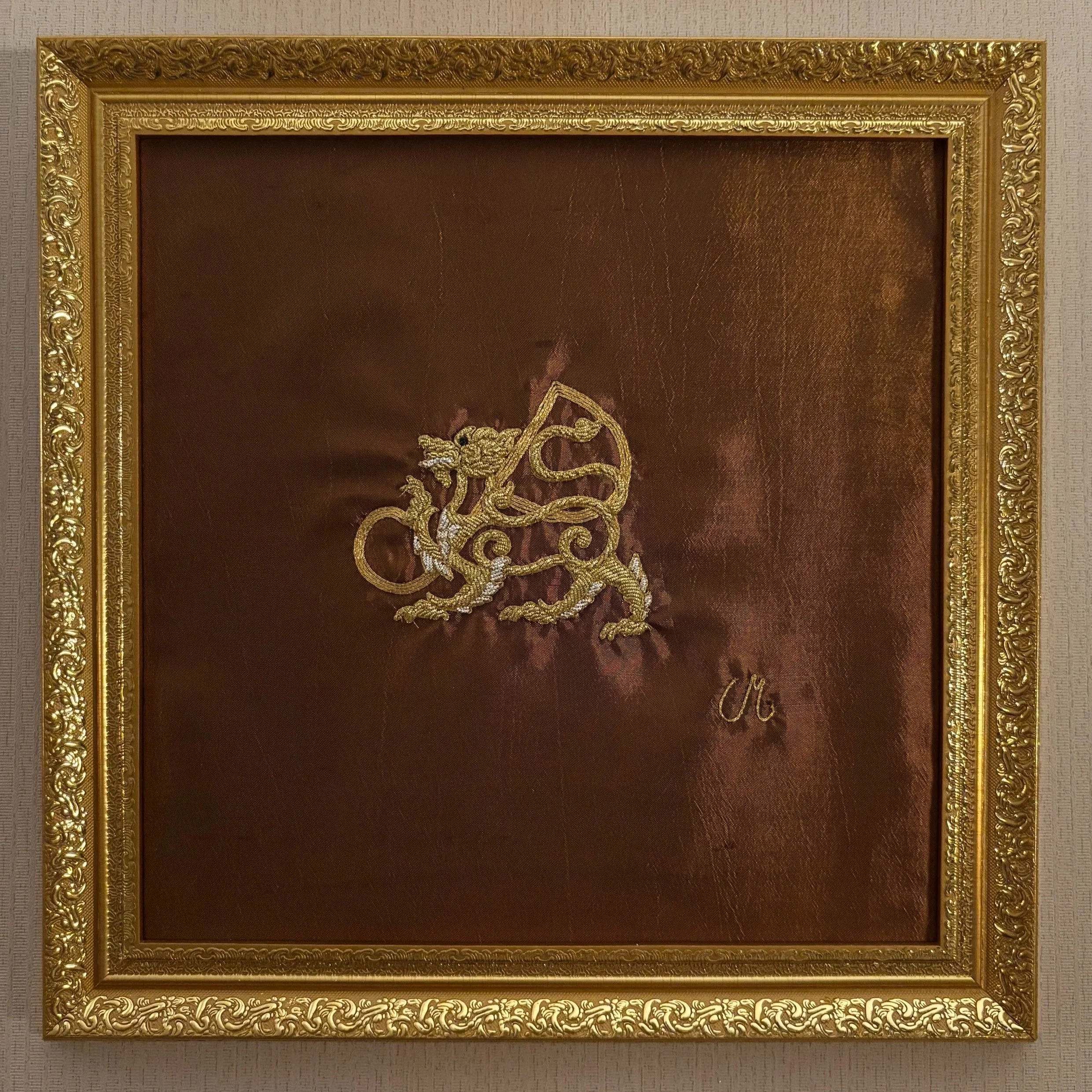
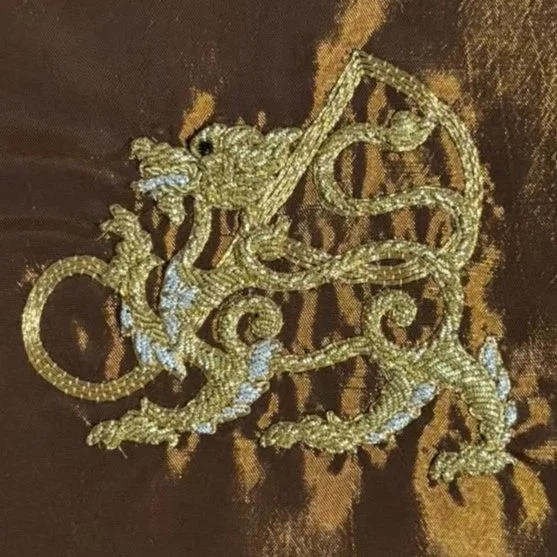
Heraldic Singha guardian lion intertwined with the initial P, high-relief gold and silver metallic bullion (canetille) with faceted bead eye detail on bronze silk taffeta, signed with the artist’s calligraphic monogram, 2025. Executed by Manola Chittarath, Luang Prabang.
The intergenerational continuity of this courtly heritage is vividly embodied by Manola Chittarath, daughter of Ajahn Phatthana Bouavong. Raised surrounded by wooden frames, metallic spools, and half-finished ceremonial panels, Manola began practising pak din at the age of eight or nine under the guidance of her mother and grandmother. Although pursuing a parallel career in the private sector, she maintains the uncompromising methods of her family’s atelier—including direct freehand drafting onto silk—out of fidelity to her lineage.
For those of us working across design, material culture, and conservation in Laos, Chittarath’s mastery invites a central curatorial question: how can a historic court craft remain vital in the present without being reduced to standardised tourist souvenirs? Today, the highest expressions of pak din are largely confined to three spheres: bridal ensembles, occasional fashion showcases, and ecclesiastical commissions such as monastic ceremonial fans (talapat). While these sustain the craft, traditional bullion-embroidered garments remain heavy, precious, and reserved for rare ritual occasions. Ensuring the long-term survival of the discipline at its finest technical level therefore requires expanding its contemporary contexts—allowing it to inhabit domestic architecture and commemorate significant life milestones through bespoke, signed commissions.
Two works executed in 2025 by Manola Chittarath for my own collection in Vientiane illustrate this dialogue between inherited Luang Prabang technique, European metallic thread, and contemporary heraldic design:
Joint Nuptial Monogram (June 2025): Worked in silver-gilt metallic bullion (fil d’or de Lyon) on deep claret silk taffeta, this panel was commissioned to commemorate my Lao wedding in June 2025. The composition unites mirrored initials (P & P) linked by a continuous sweeping cord beneath a five-tiered Lao architectural finial (that), translating courtly ornament into a personal dynastic emblem. In the lower right corner, Manola has signed the work in metallic thread with an M, asserting clear individual authorship.
Heraldic Singha Emblem (2025): Executed in high-relief gold and silver bullion on bronze-toned silk taffeta, this panel was created and presented by Chittarath to mark the conclusion of my tenure at Caruso Creations in 2025. Close inspection reveals an intricate layering of gauges and techniques: parallel rows of fine laid metallic threads form the underlying letter P, over which a stylised guardian lion (Sing or Singha)—a classical emblem of royal protection and dignity in Lan Xang iconography—is sculpted in heavy spiralled coils (canetille). Contrasting silver bullion articulates the creature’s jaw, chest, and leg tufts, while a dark faceted bead is set into the eye. The artist’s calligraphic monogram is signed in metallic thread in the lower right.
VI. Conclusion: Living Material History
These reflections also formed the basis of my contribution to a recent cultural documentary written and directed by Vongmany Thepphavong with the support of the Department of Information, Culture and Tourism in Vientiane. Filming both inside the Ban Na Luang workshop and alongside contemporary collectors, the production examined how architectural placement and private patronage can anchor pak din in modern Lao cultural life.
Viewed alongside historic Lao diplomatic porcelain and archival paper currency, these signed 2025 panels confirm that material culture is never solely retrospective. When Lyon metallic bullion meets the freehand discipline of a Luang Prabang master, a courtly visual language forged over centuries continues to speak with clarity and authority in the present tense.
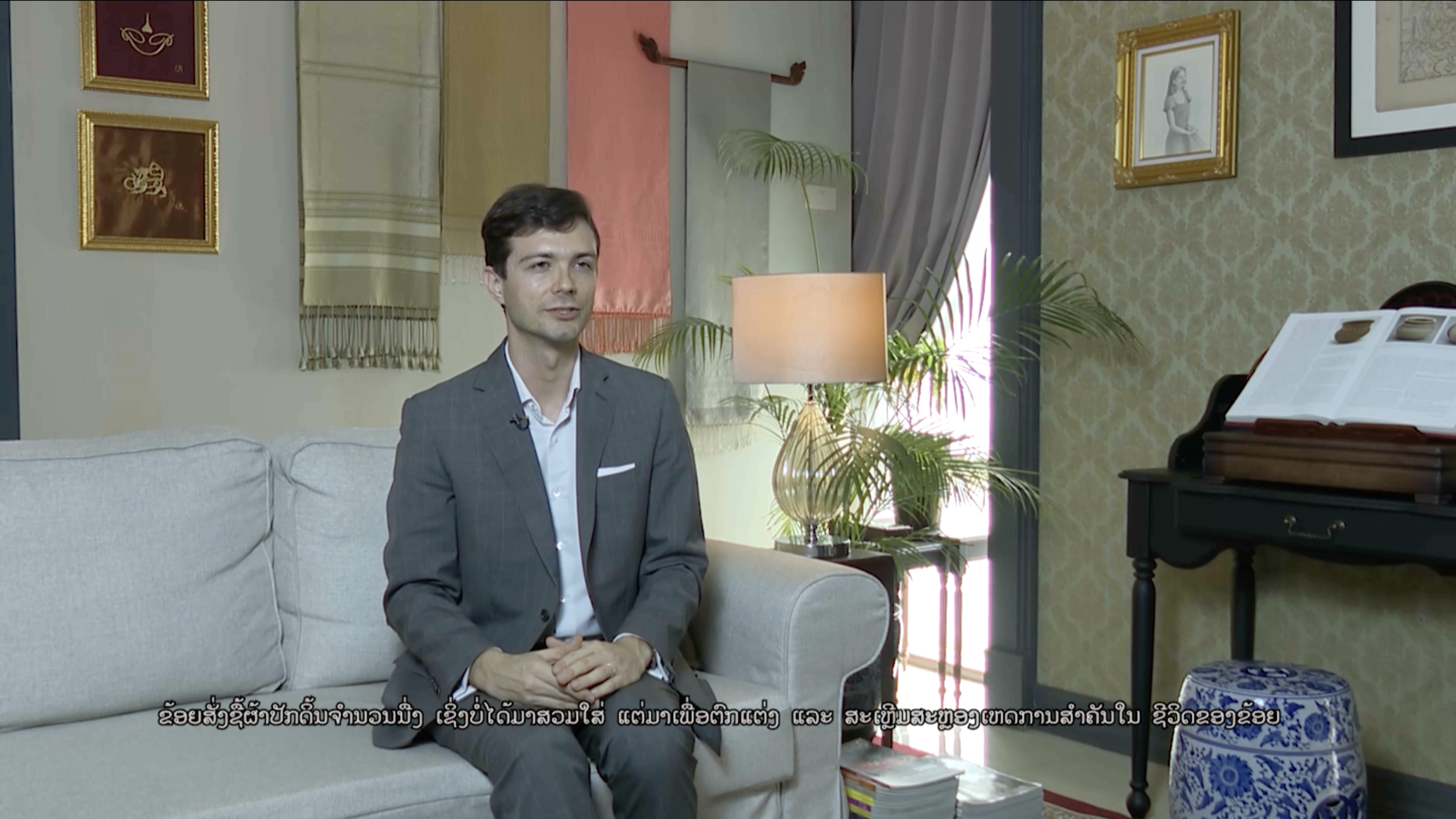
Pietro A. Chiarini interviewed in Vientiane during filming on the contemporary patronage and preservation of Luang Prabang pak din embroidery.
Bibliographic & Visual Notes
Primary Documentary Source: Pak Din: The Art of Luang Prabang Metallic-Thread Embroidery (ປັກດິ້ນ), cultural documentary written and directed by Vongmany Thepphavong, produced with the support of the Department of Information, Culture and Tourism (Phanaek Vatthanatham lae Thongthiao), Vientiane, Lao PDR. Featuring interviews with Ajahn Phatthana Bouavong, Manola Chittarath, Khounphithak Ratisavath, Phetdaovone Philavanh, and Pietro A. Chiarini.