
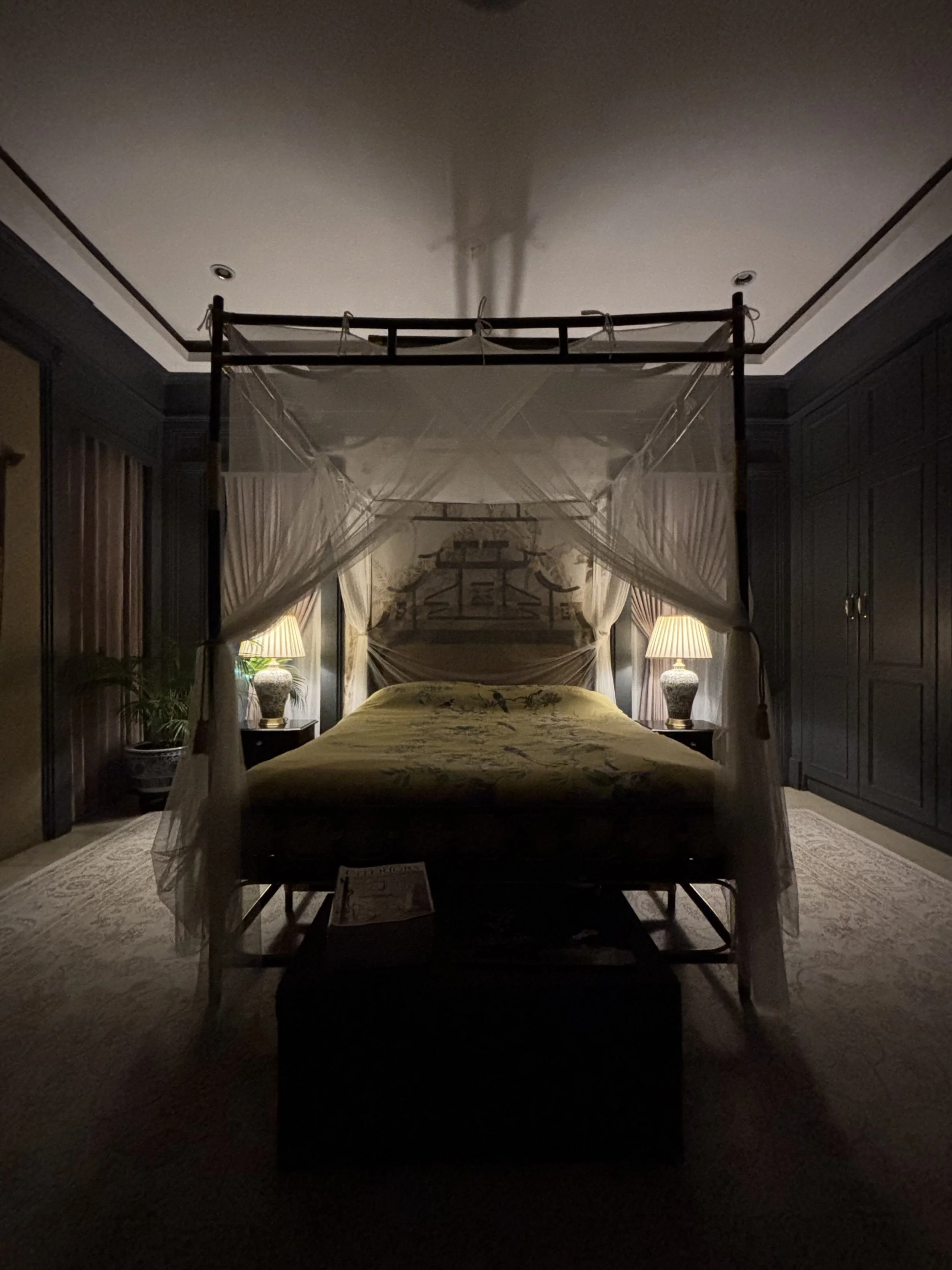
Inside the private residence of Pietro A. and Patay Vongsombath Chiarini in Vientiane, the bedroom serves as an intimate laboratory of East-West dialogue. Rather than relying on imported luxury, the space was conceived to reimagine a contemporary urban apartment through the lens of 19th-century Indochine heritage, combining custom furniture crafted by local Lao artisans, antique court textiles from Luang Prabang, and heirloom Asian porcelain.
In residences where living becomes a biographical essay and an aesthetic map of the soul, the bedroom emerges as a true sanctuary, suspended in a cultured balance between the composed solemnity of British Colonial taste and the fairytale allure of Indochine aesthetics. Every material, pairing, and play of light reflects a deliberate layering of memory, fine craftsmanship, and exotic inquiry.
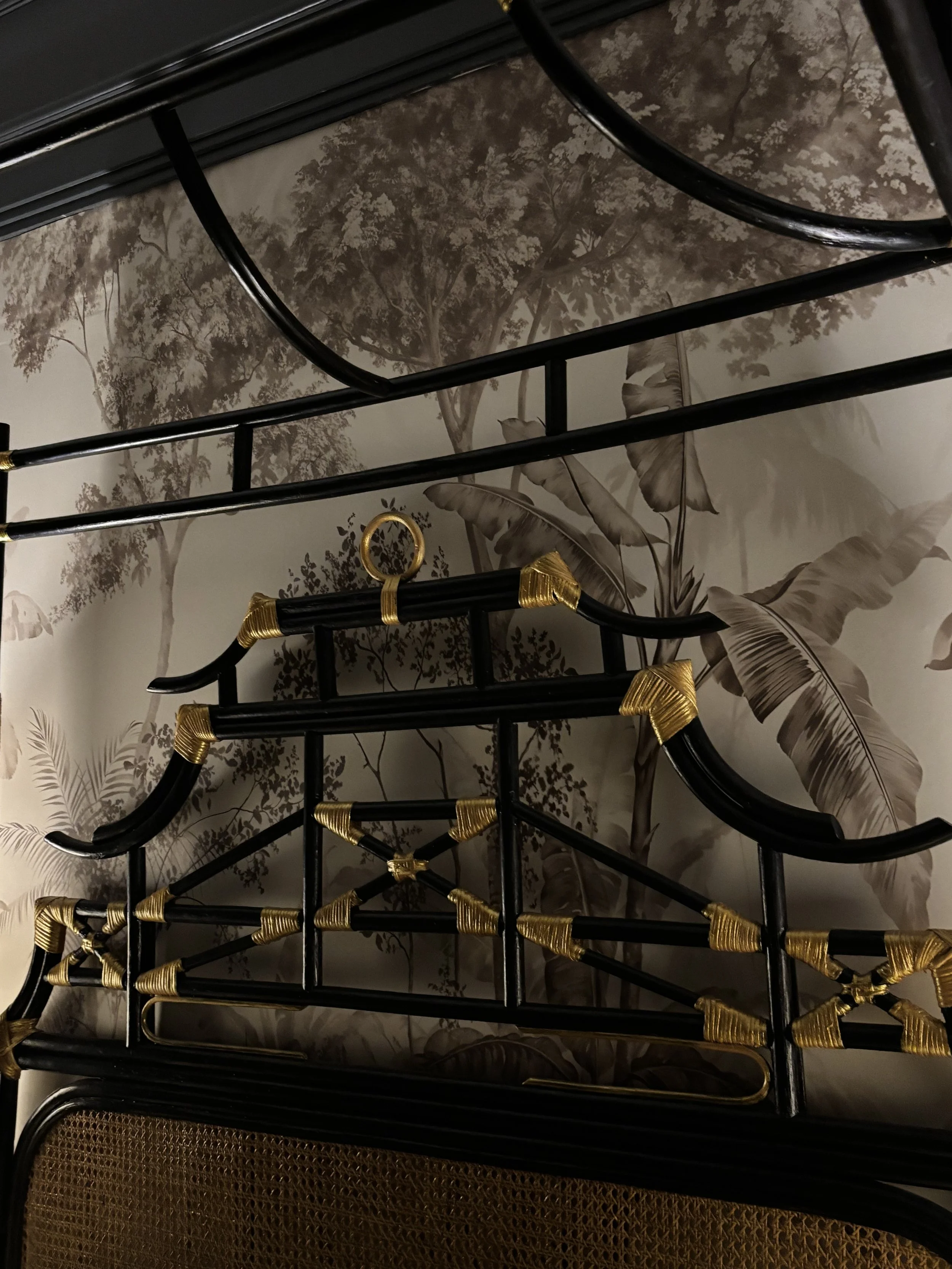
Commanding the room is the majestic four-poster canopy bed, built to an original design by Pietro A. Chiarini and executed in Vientiane in 2023. Its deep, black-lacquered rattan frame is accented with gilded rattan joints that gracefully punctuate the verticality of the posts. The headboard pays tribute to 18th-century chinoiserie, curving the reeds into an intricate pagoda silhouette that lends an ethereal lightness to the solid geometry of the frame and its woven cane backrest. Sculptural draperies of cotton voile cascade around the posts, gathered by gold tassels to transform the bed into an intimate, sheltered alcove. Dressing the bed is a rich mustard-yellow bedspread, finely hand-painted with birds and flowering branches, whose subtle sheen converses with the pale tones of the large area rug, patterned with stylized terracotta and sand motifs that anchor the floor with visual continuity.
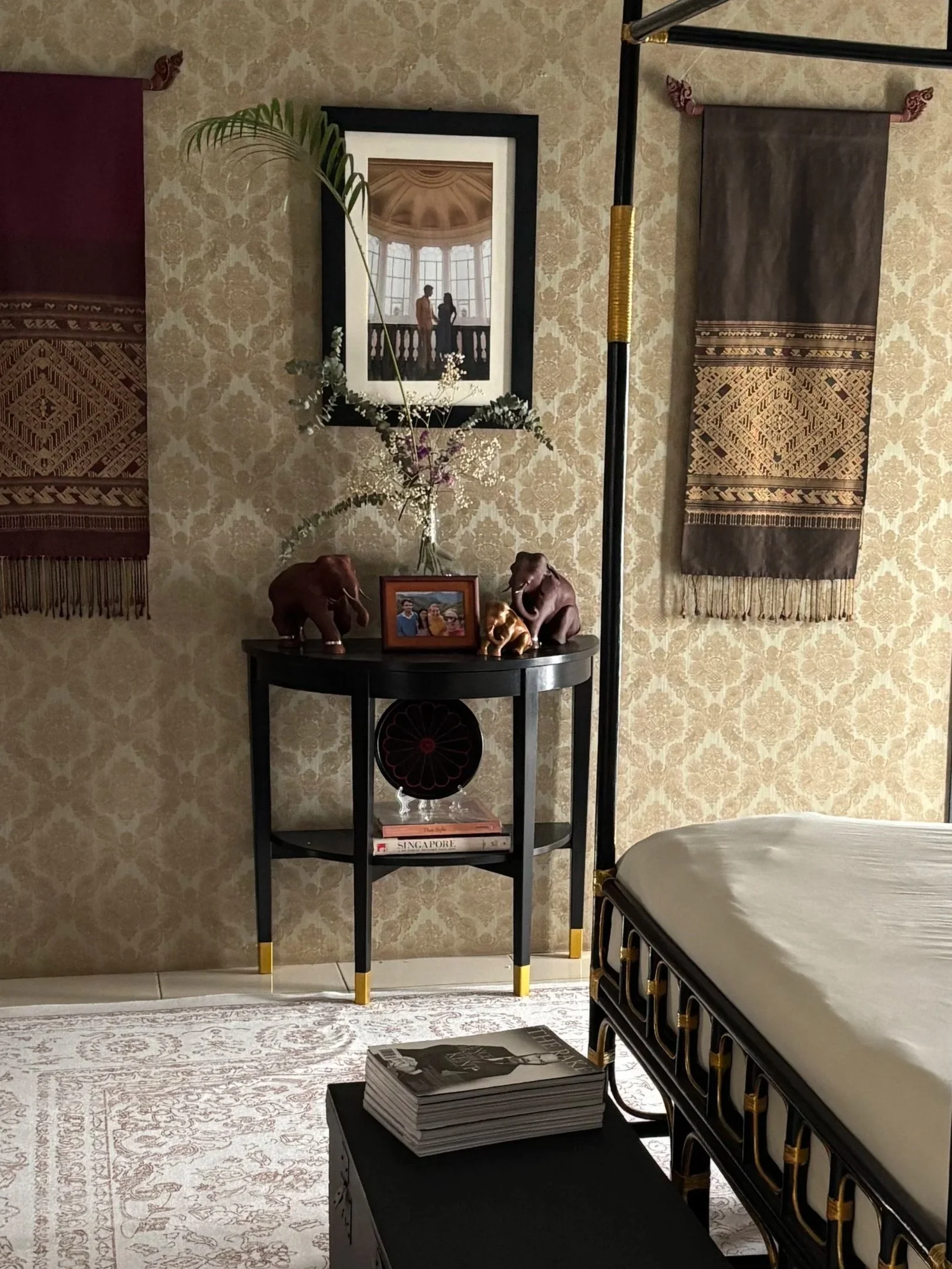
The room is enclosed by wall architecture of quiet intellectual rigor: deep molded boiserie in austere lead grey frames silk damask wallcoverings in warm champagne and sepia hues. Mounted upon them with gallery-like symmetry are rare antique Lao textiles—large court-silk pha biang hand-woven with intricate geometric patterns in supplementary gold-thread weft, in shades of brown and burgundy, stretched over finely carved wooden supports from Luang Prabang.
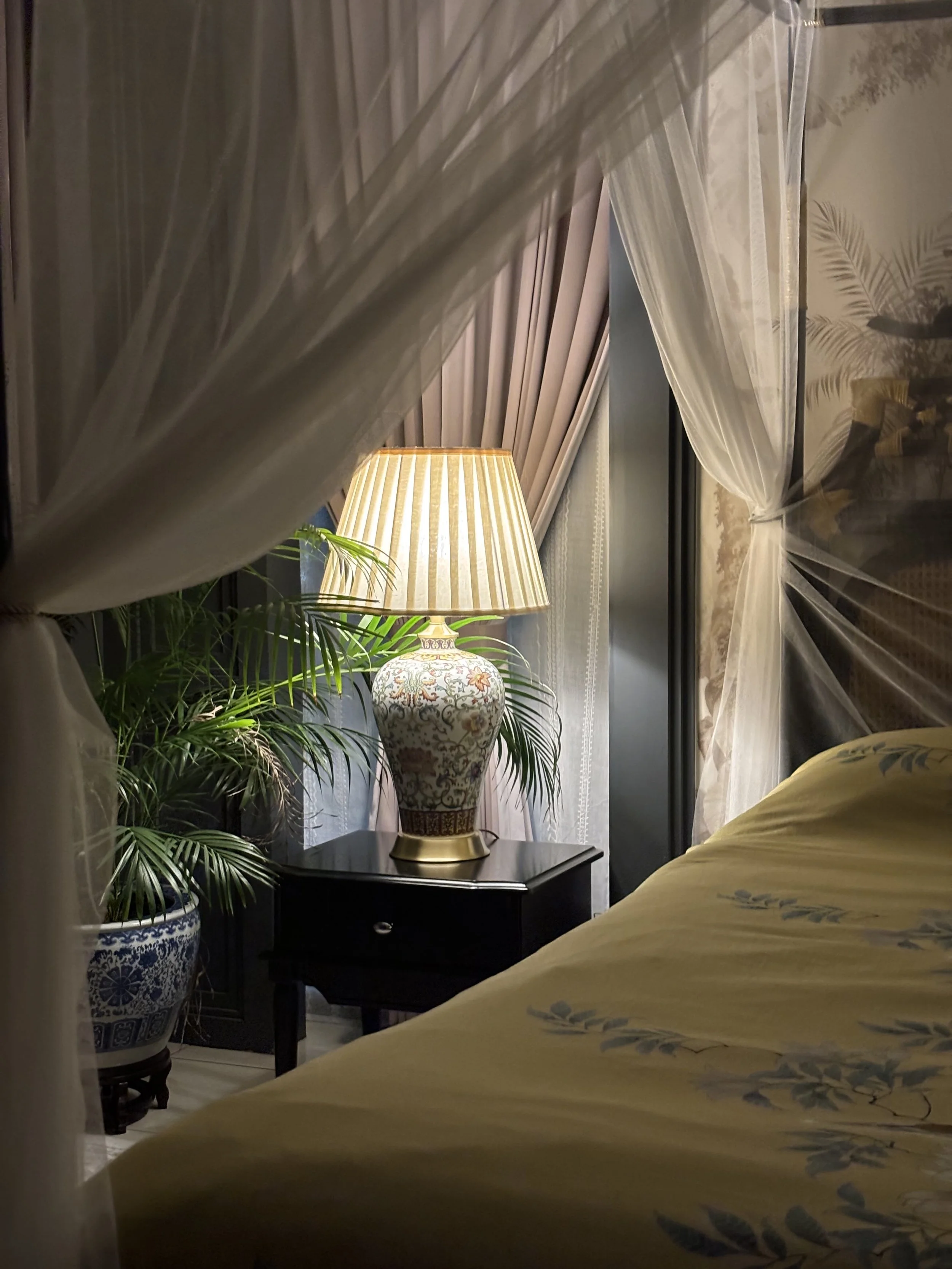
Evening light diffuses with a soft, ritual warmth from a pair of imposing table lamps, their bases crafted from large Chinese porcelain baluster vases in the Qianlong tradition, richly enameled in polychrome famille rose. Dense scrolling lotuses, vegetal volutes, and geometric motifs in iron red, green, and yellow intertwine across the glazed bodies, topped by sophisticated ivory fabric empire shades with box pleating.
Surrounding the canopy is a thoughtful curation of bespoke pieces and antiques. At the foot of the bed sits a black-lacquered traveler’s trunk with dark wrought-iron hardware, stacked with art monographs and refined lacquer japonaiserie. Nearby against the wall, a two-tiered demilune console in dark lacquered wood with gold-leaf tips displays personal mementos alongside a plate decorated with an imperial chrysanthemum motif in red and gold enamels: ceremonial elephants carved in rosewood with silver accents gather around a framed photograph taken at the Gia Long Palace in Saigon during Pietro and Patay Vongsombath Chiarini’s engagement in December 2023.
Completing the space, an Oriental-inspired dark wood valet stand displays court tailoring and crisp Asian silks—qipao, sinh, and pha biang—while full-length curtains in powder-pink and bronze taffeta fall in generous sculptural folds, enveloping the room in a quiet, timeless atmosphere.