
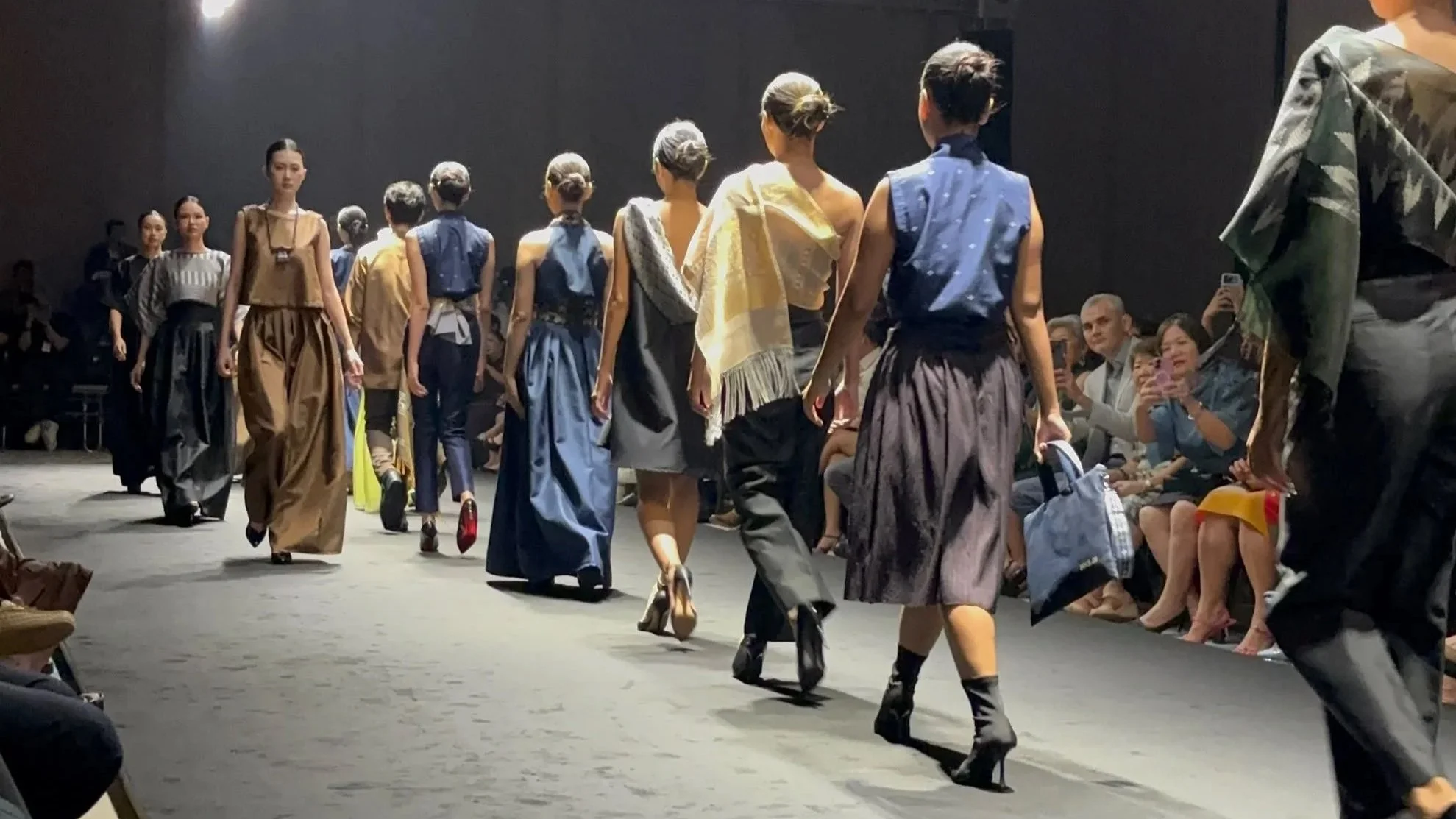
The closing procession of KHANG’s collection on the opening night of Lao Fashion Week 2026 at Amari Vientiane, pairing structured northern Lao silk tailoring with sheer hand-dyed organzas.
When the thirteenth edition of Lao Fashion Week opened its runway programme at Amari Vientiane on Friday evening, following an official reception at the French Residence earlier in the week, the opening slot went to Viengkham Nanthavongdouangsy. Working under her label KHANG, she has spent decades researching and weaving the textile traditions of northern Laos, and her presence at the start of the evening set a clear standard for this year’s theme: Local to Global: Value Our Heritage.
Across Southeast Asia, fashion weeks often struggle with how to treat indigenous textiles without reducing them to costume or surface decoration. Several labels on Friday’s schedule, including Vientiane’s Ministry of Silk alongside visiting regional designers, approached Lao silk with genuine respect for fibre and drape. KHANG’s collection went a step further, relying on architectural restraint rather than easy nostalgia.
Born into a family of weavers and trained at the loom from the age of six, Nanthavongdouangsy has long drawn on the supplementary-weft traditions of northern Laos, from Tai Daeng to Tai Phuan communities. Rather than cutting up antique ceremonial skirts for decorative patches, she worked from the structural logic of the cloth itself. Deep indigo, bronze, and charcoal silks were tailored into clean, columnar dresses, cropped jackets, and wide-legged trousers, with handwoven geometric bands integrated directly into collars, waistlines, and sleeves as structural trim.
Much of the strength of the collection lay in its handling of weight and light. Against the dense matte sheen of heavier hand-loomed silk, she layered sheer silk organzas dyed in pale gold, lime, and muted sage. In motion down the dark runway, the translucent panels caught the overhead lights like filtered afternoon sun, softening the strict geometry of the tailoring without obscuring the construction underneath. Fringed one-shoulder stoles worn over tailored trousers, a bronze tunic crossed by an asymmetrical woven band for menswear, and structured silk bags showed how traditional supplementary-weft patterns can anchor modern proportions.
Handwoven silk from Houaphanh or Luang Prabang is too often discussed solely in terms of preservation, as though it belonged exclusively in museum cases or diplomatic gifts. On Friday night in Vientiane, Viengkham demonstrated the opposite: that when a designer understands both the tension of the warp on the loom and the cut of a contemporary garment, heritage needs no special pleading to hold its place on an international stage.