
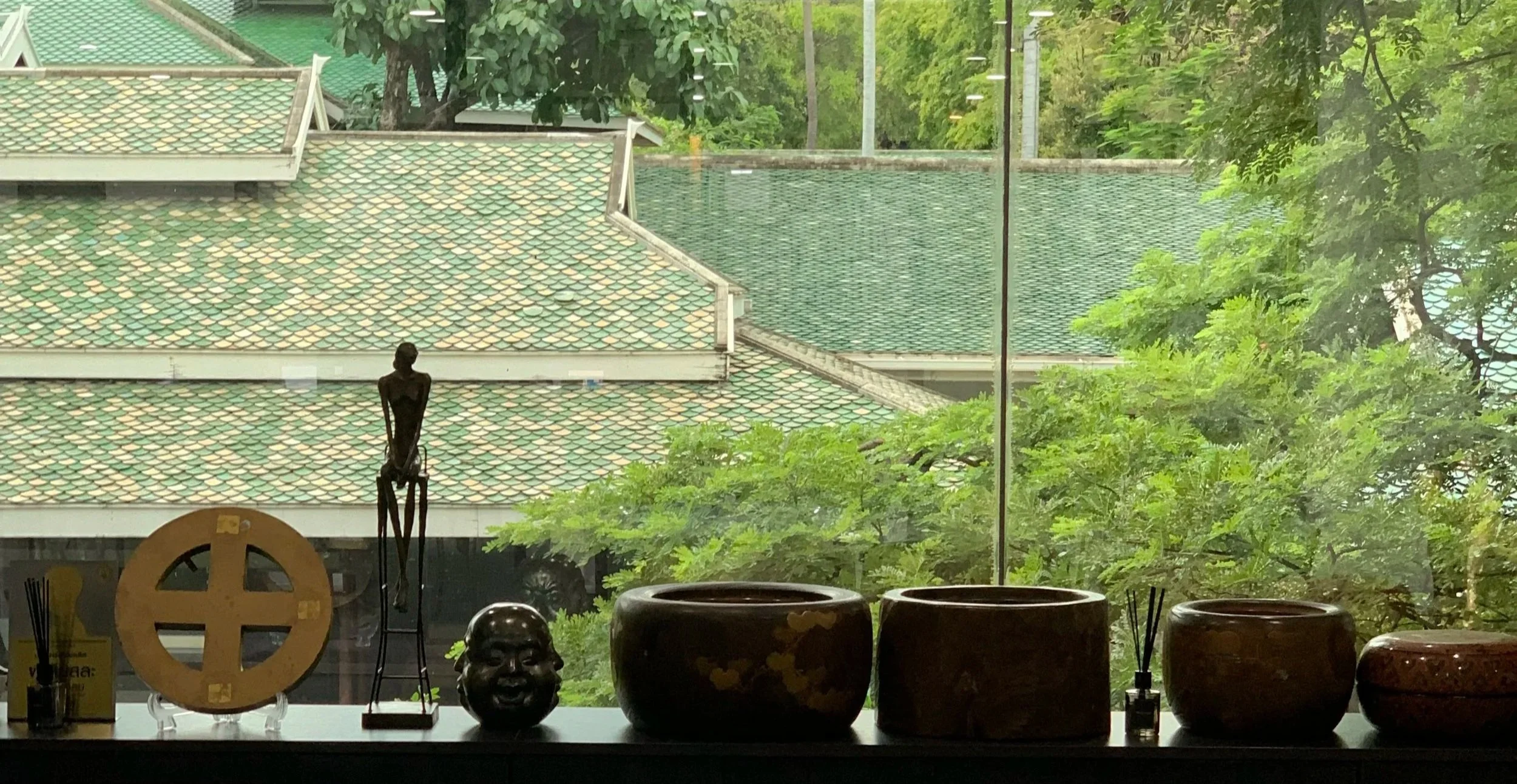
Photographed at Nai Lert Park Heritage Home in Bangkok during a meeting with Khun Naphaporn Bodiratnangkura, with the residence’s signature green-tiled roofs rising beyond the glass.
When I first arrived in Laos, it was for academic research, a master’s thesis conducted alongside the National University of Laos and international organisations, examining the legacy of unexploded ordnance and the complex diplomatic history between Laos and the United States.
What began as a scholarly posting, however, gradually led me back to an older devotion: the art of interiors, antiquities, and craftsmanship. Since childhood, I had been drawn to the quiet authority of historical objects. My uncle’s antique gallery in Italy became my first true school, a place filled with heirloom porcelain, art de la table, and objets d’art, each carrying its own lineage of provenance, proportion, and taste.
In Laos, that early sensibility found new resonance. Here, I encountered a culture where ancient artisanal traditions and modern imagination coexist, and where the royal legacy of Lane Xang meets the faded grace of colonial Indochina. Wandering through timeworn French villas, visiting local ateliers, and exploring the craft traditions of mainland Southeast Asia, I realised my eye had always been oriented toward the East—foreshadowed by the chinoiserie pieces that had captivated me as a boy.
My years as Executive Director at Caruso Creations refined that instinct into discipline, teaching me how creative vision becomes form, and form becomes narrative. Today, through Grand Laos, I continue that trajectory: sharing the measured depth of Laotian heritage, celebrating the master hands that preserve it, and curating spaces and objects defined by historical integrity and contemporary poise.
Those who have spent time in Laos understand its understated allure. Through these pages, I hope to bring a fragment of that world to yours—a reminder that art, at its finest, is not merely collected, but lived.