
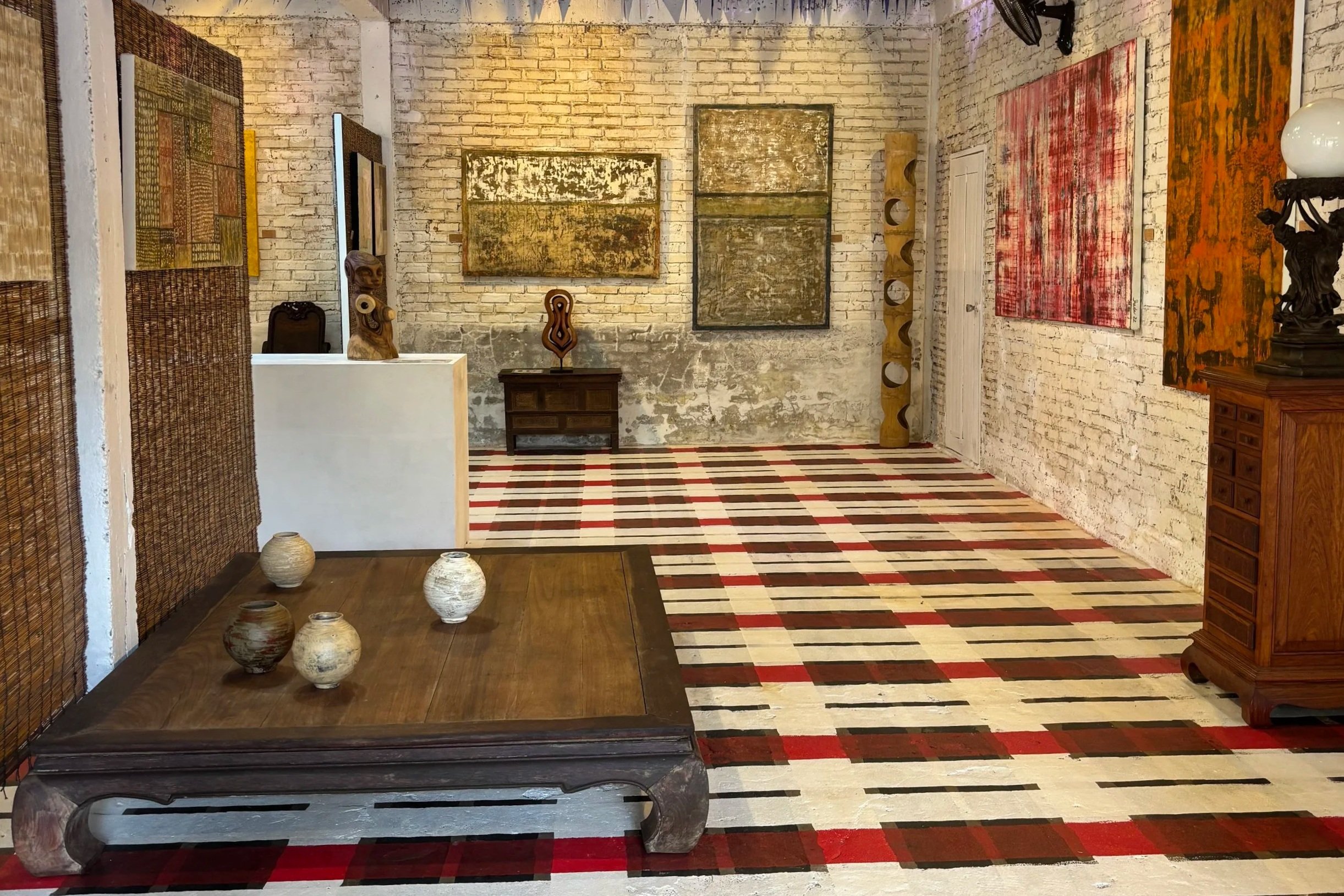
Shada’s showroom in Vientiane, where domestic architecture and studio practice converge into a single working gallery.
Paris-born Michel Marcel Saada, known professionally as Shada, began his artistic journey over thirty years ago when curiosity and wanderlust brought him to what he calls his “Mount Athos”: the tranquil, secluded landscapes of Laos. Though a successful entrepreneur, it is ultimately art and material experimentation that define him. Even in his earliest works, Shada sought to transform the humble into the unexpected, turning coconut shells into stippled mosaics and crafting delicate marquetry from inlaid eggshell and grains of rice.
“Each canvas records my energy in the moment. It is both a reflection of intuition and a conversation with the material itself.”

Shada’s open-air studio in Vientiane, where daylight, pigment, and unhurried intuition guide each gesture.
Drawn to twentieth-century abstraction—from Pierre Soulages’s luminous blacks and Jackson Pollock’s dripped canvases to Gerhard Richter’s layered surfaces and Mark Rothko’s chromatic fields—Shada has absorbed these lessons without imitation. Each canvas becomes an arena for discovery, where line, colour, and pictorial depth interact in unexpected ways, extending the same spirit of inquiry that marked his early travels.

Two of Shada’s wood sculptures, hewn from antique timber beams, set within his living quarters among works on canvas.
His working method is expansive and physical. Paint is poured, dripped, brushed, pressed, and layered with apparent freedom, yet every gesture rests on long discipline. Blots and splashes that appear spontaneous at first glance emerge from years of material control, settling naturally into a recognisable idiom. He describes his paintings as records of energy and temperament, balancing impulse and contemplation in densely textured compositions: some canvases appear to glow from within, while others fracture into movement and colour.
The artist’s house itself forms part of this continuum. Rebuilt from the ground up in Vientiane, the residence functions as a habitable sculpture in which the open garden workshop and the exhibition rooms sit side by side. Moving through the space, one remains constantly aware of the physical act of making—surrounded by weathered timber, raw pigment, and unfinished studies. Rather than presenting a static retrospective, the house offers an unmediated encounter with how an artist lives, builds, and thinks through matter.