
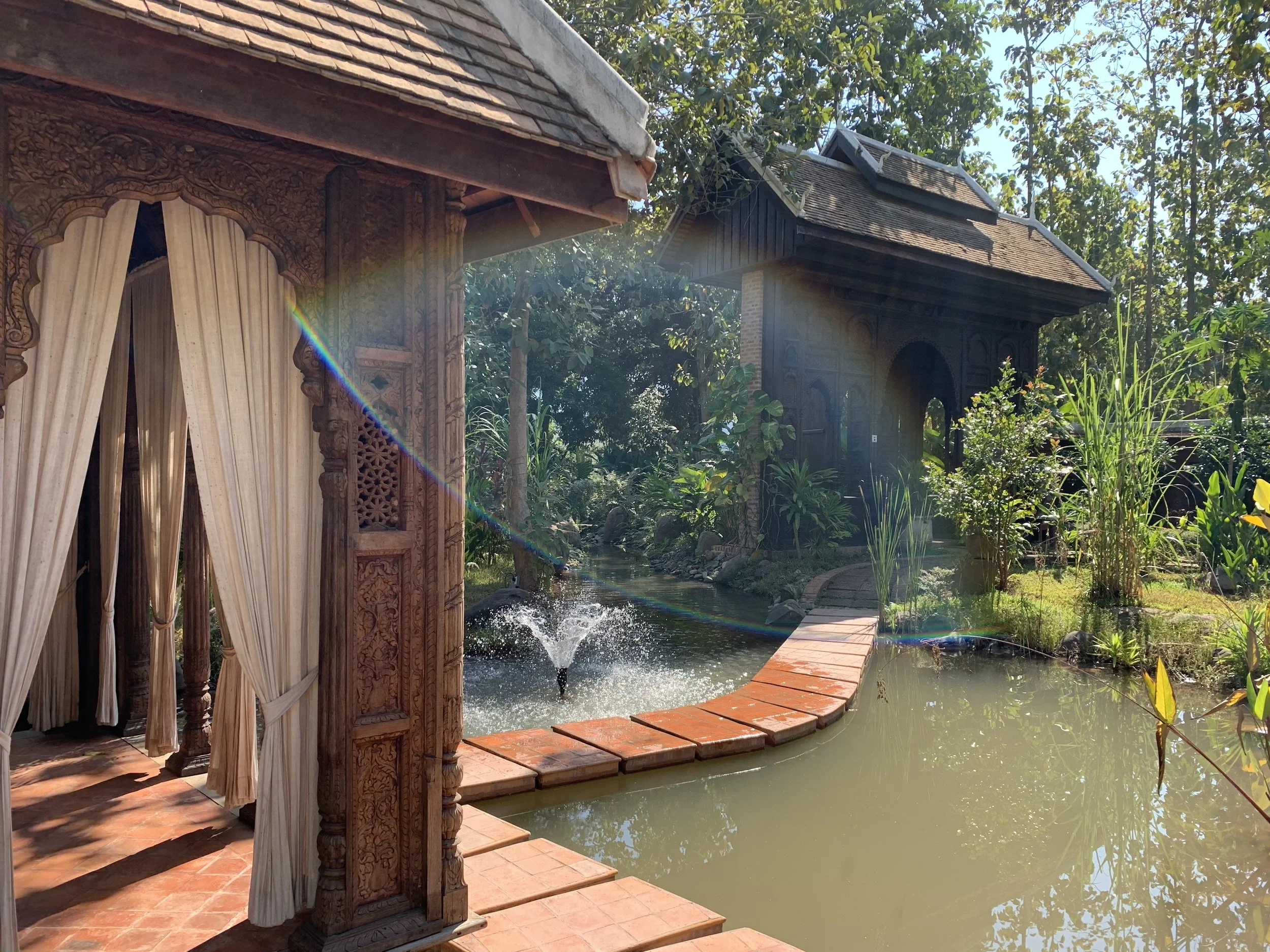
Draped cotton curtains framing an open timber pavilion above the water at Château Orientale, Luang Prabang, softening the direct glare of the afternoon sun.
In an interior shaped between Italy and Laos, harmony rarely comes from matching colours. It relies instead on how surfaces absorb or return light, how distant objects are permitted to breathe, and why an abundance of low lamps remains the one excess a room can always afford.
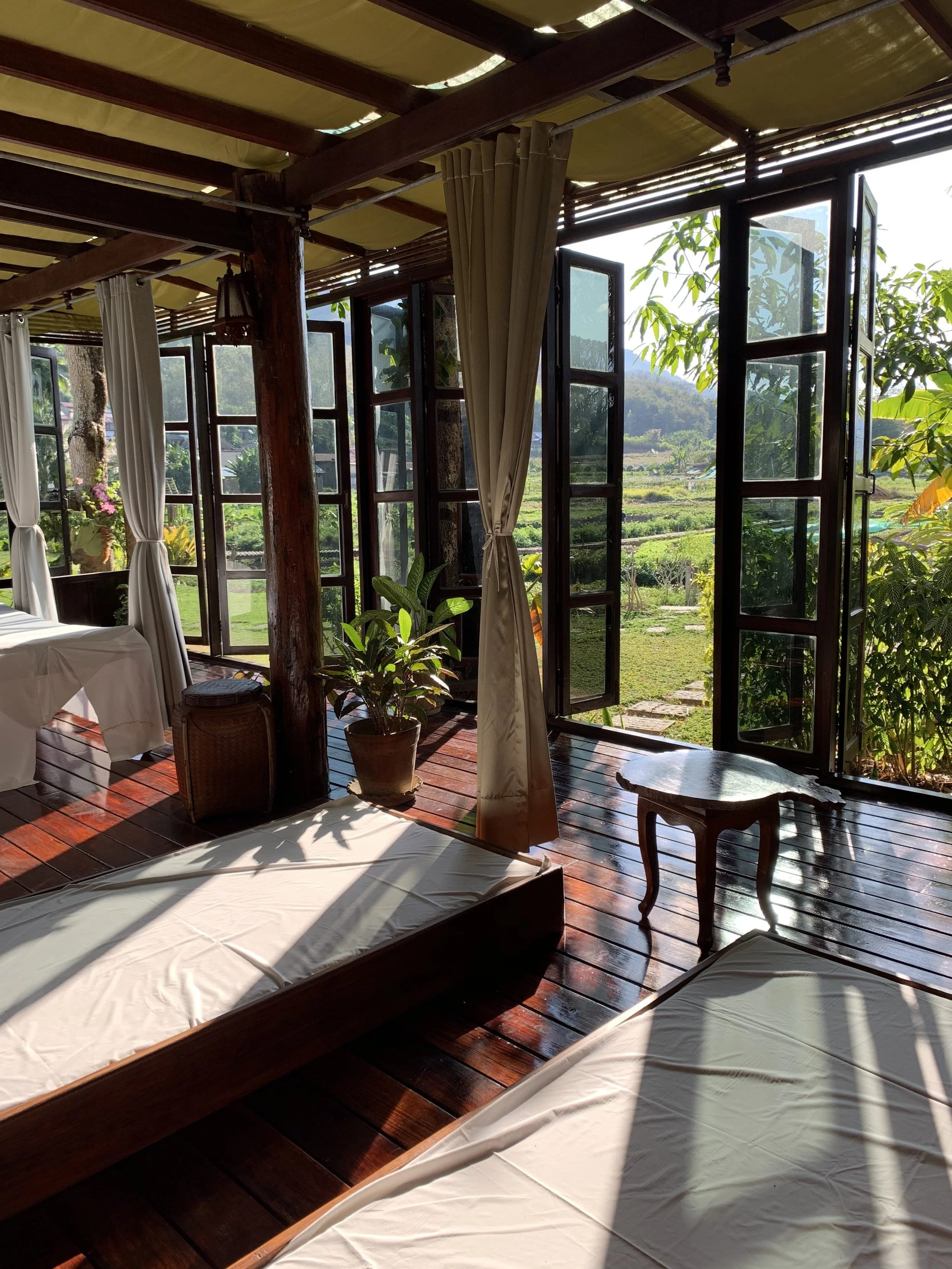
Symmetrical lengths of tied fabric functioning as architectural wings in the open-air spa at Villa Santi Resort, Luang Prabang, mediating between the shaded interior and the rice fields beyond.
I. Filtering the Vertical Sun
Anyone who has spent time in the Mekong valley knows that tropical daylight is not merely bright; it is vertical, flat, and relentless. Unlike the oblique light of northern Europe, which softens edges and flatters pale walls, the midday sun in Laos bleaches surfaces and flattens depth unless it is interrupted before entering the room.
I first understood the architectural value of fabric as a climatic filter in Luang Prabang, first beneath the open-air pavilion of Château Orientale, and later in the garden spa of Villa Santi Resort. There, lengths of pale linen and mosquito netting were drawn back and knotted like theatrical wings along timber posts, transforming open verandas facing the water and the rice fields into layered thresholds. Rather than sealing a room against the outdoors, draped textiles break the glare, slow the eye, and allow air to move while casting a gentle, shifting shadow across the floor. That lesson has stayed with me ever since: in a warm climate, a curtain or a gathered canopy is never mere ornament; it is an instrument for regulating light.
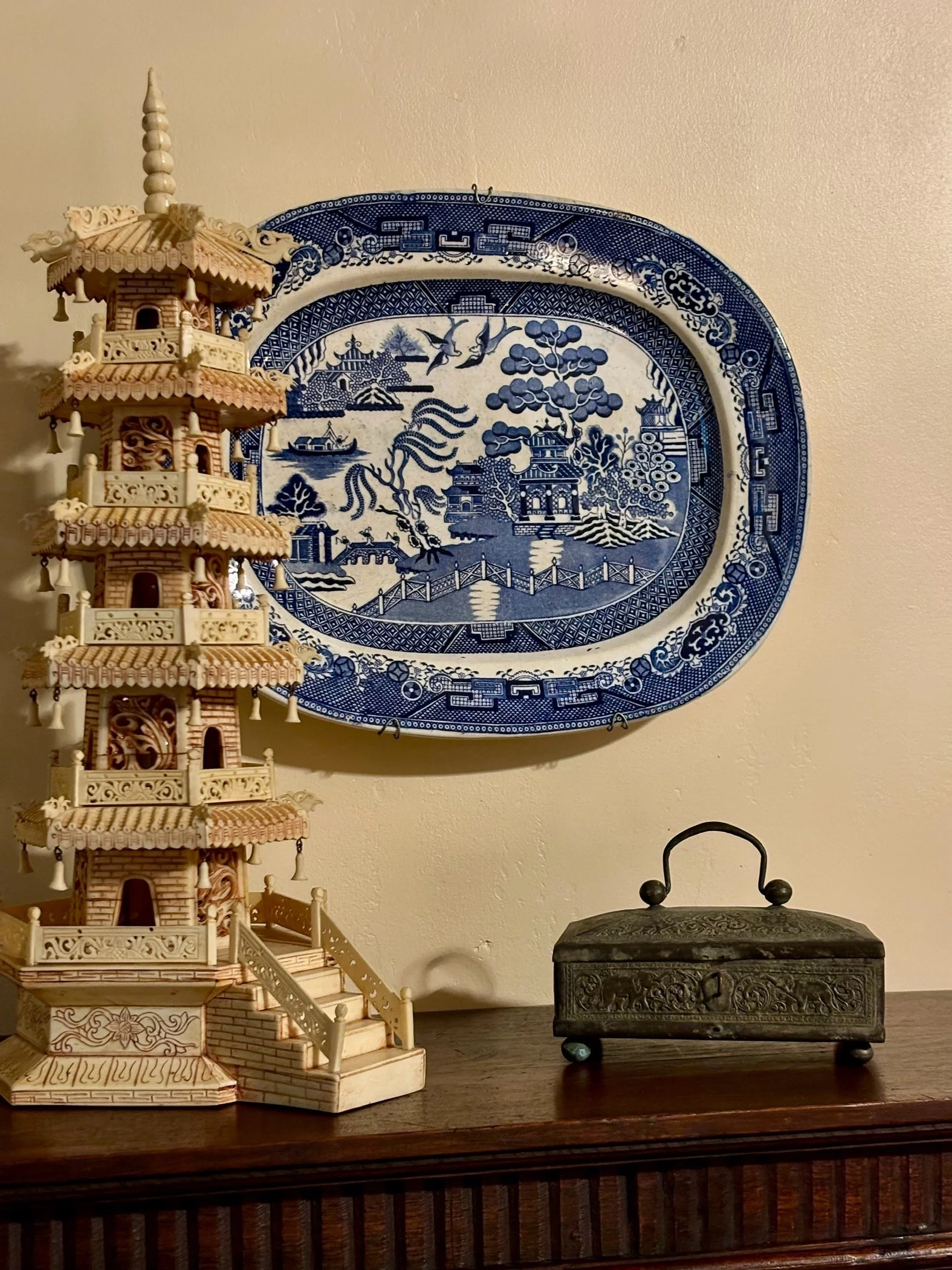
A nineteenth-century blue-and-white Willow platter balanced by the matte textures of a carved bone pagoda and an early twentieth-century Lao or Northern Thai repoussé metal casket with elephant frieze.
II. The Dialogue of Opacity and Shine
Once light is softened, the character of a room depends on the conversation between matte and reflective surfaces. When arranging objects, whether on a dark timber chest in Vientiane or an antique table in Italy—I have found that glazed and polished pieces rarely succeed in isolation. They require the grounding presence of something porous, patinated, or rough.
Consider the pairing of blue-and-white transferware porcelain with carved bone and aged metal. A large nineteenth-century Willow-pattern platter mounted on a pale wall possesses an immediate visual brightness: its high-fired glaze catches the light, and its cobalt narrative demands attention. To set a tall Chinese porcelain vase directly in front of it simply for the sake of thematic consonance would be a mistake: two glossy surfaces competing at close quarters until both are diminished. Yet when the same platter is flanked by an intricate multi-tiered pagoda in carved bone and an early twentieth-century Lao repoussé metal casket darkened by decades of handling, the tension resolves. The matte, slightly warm grain of the bone and the softened relief of the striding elephants on the casket absorb the glare of the ceramic glaze, anchoring the composition.
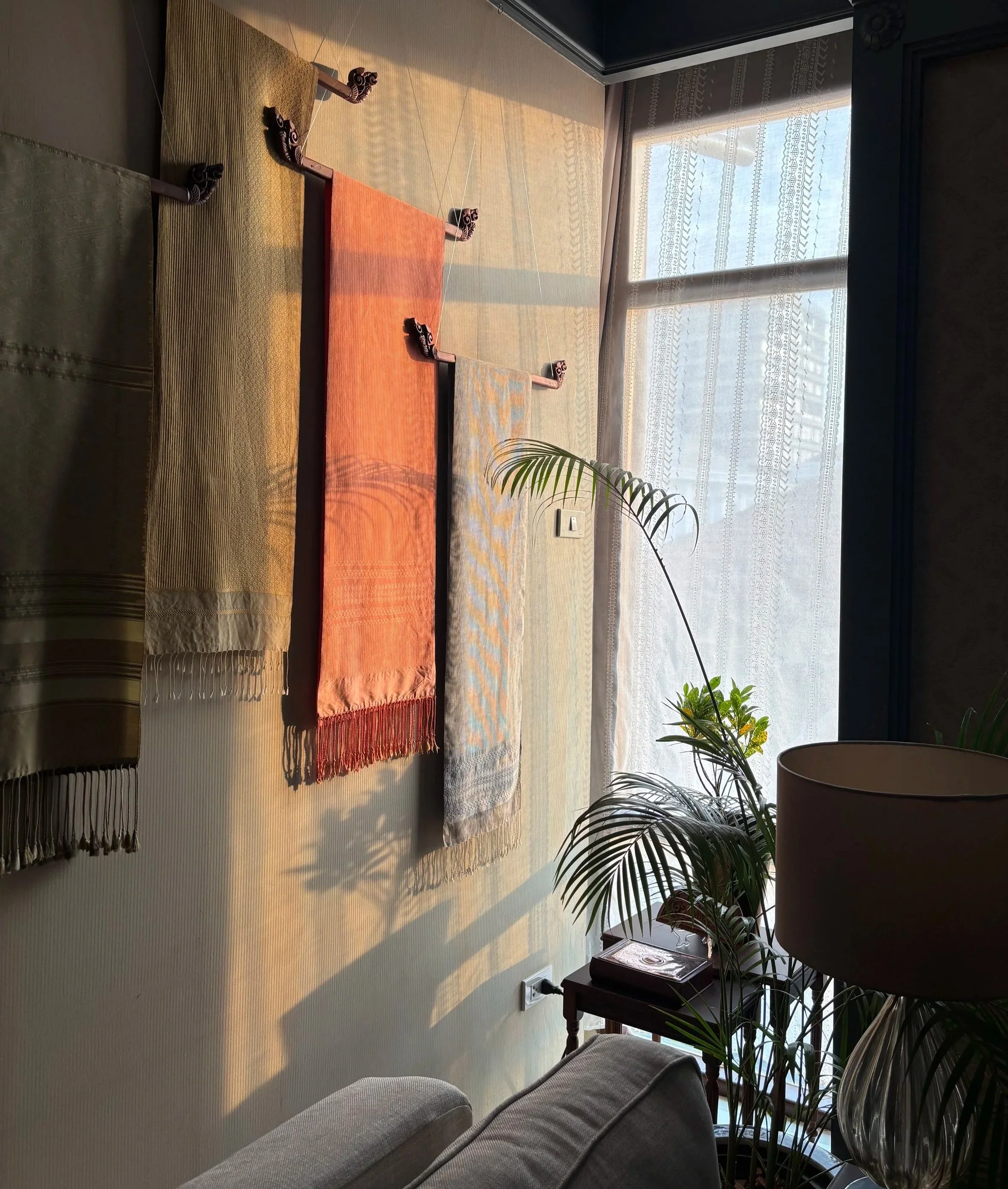
Contemporary Lao woven silk organzas and ribbed textiles suspended from carved wooden rods, catching raking afternoon light filtered through a patterned sheer curtain.
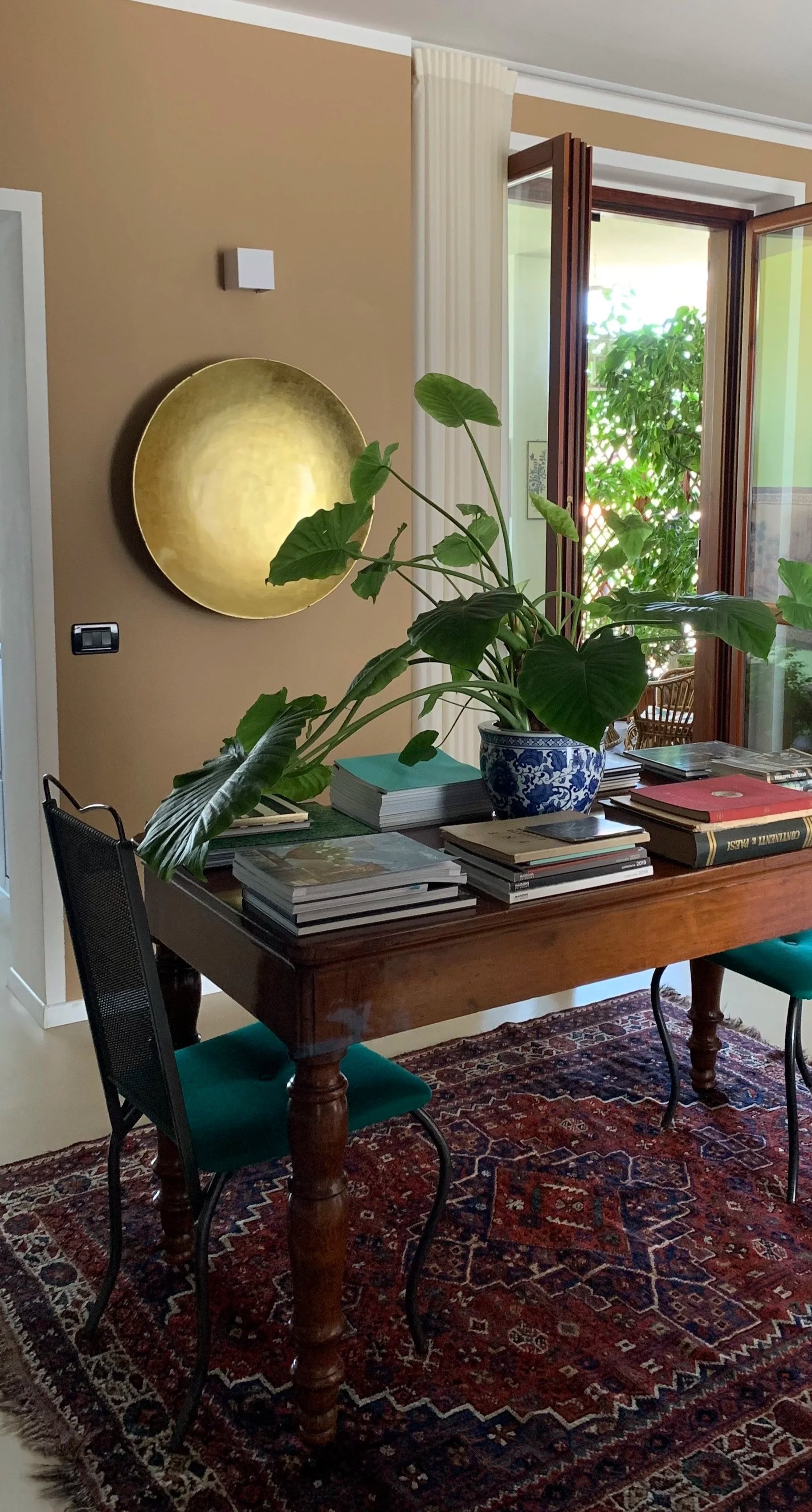
In Italy, a hand-gilded Indonesian lacquer dish and a blue-and-white porcelain jardinière bring controlled sheen to an antique walnut desk and warm plaster walls.
The same instinct applies to textiles and gilded surfaces. Against a wall hung with contemporary Lao woven silks—organzas, ribbed weaves, and subtle lotus motifs suspended from carved wooden rods, filtered afternoon light reveals the irregularity of the thread rather than bouncing off it. Even in Italy, where a large Indonesian gold-leaf lacquer dish hangs above a nineteenth-century walnut desk beside a blue-and-white jardinière, the gold works precisely because its surface is hand-burnished and softly concave rather than mirror-bright. Highly polished silver alongside glossy porcelain belongs almost exclusively to the formal dining table, where candlelight and crystal deliberately heighten brilliance; in a living room, aged, unpolished metal almost always proves the wiser companion.
III. Hierarchy and the Virtue of Evening Lamps
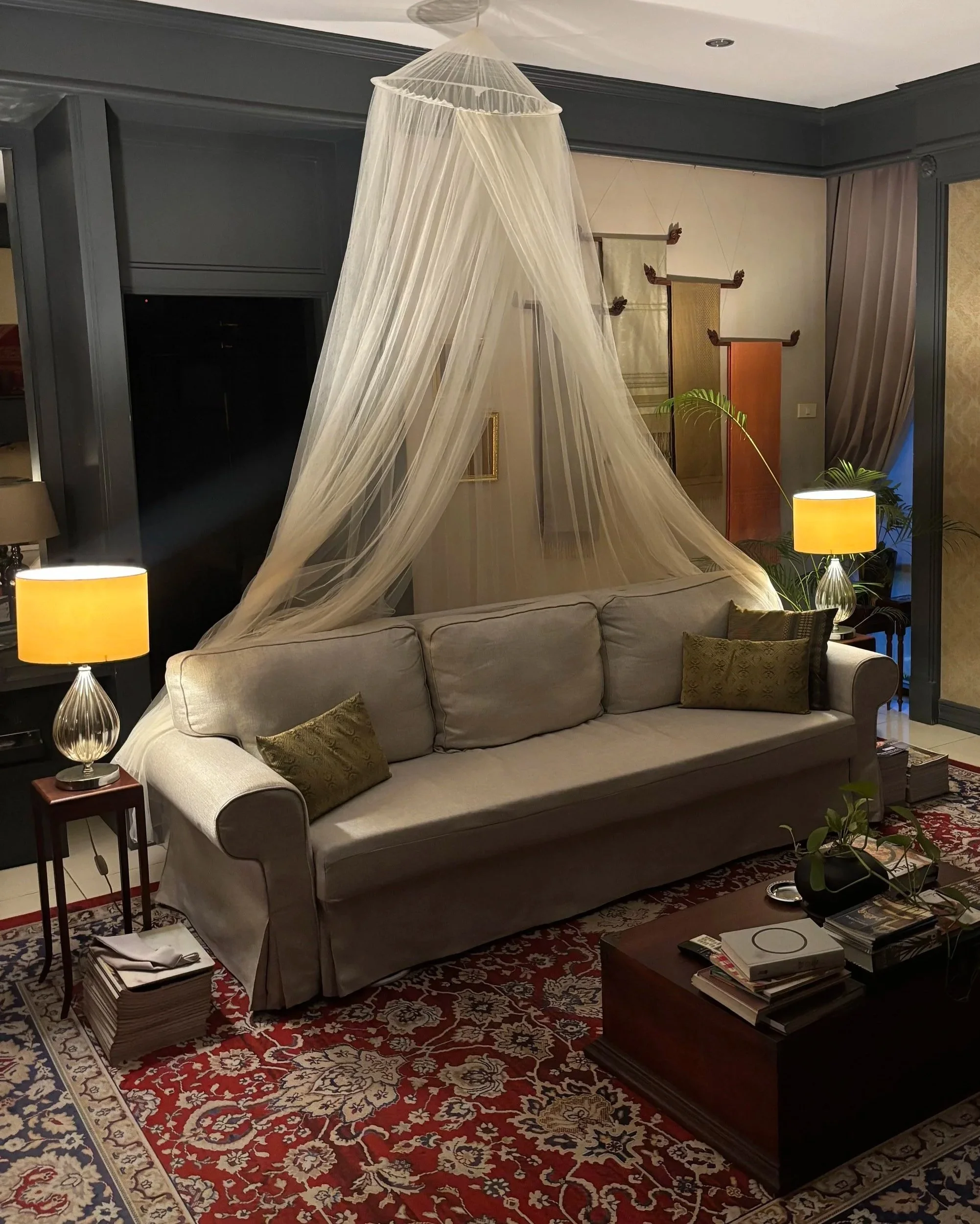
At dusk in Vientiane, low shaded lamps and a gathered canopy soften the dark grey panelling, creating pools of warm reflection across the room.
Every arrangement of objects requires a clear hierarchy. When two pieces of equal visual weight are placed too close together, neither commands the eye. A room breathes only when major pieces are separated by quiet intervals—a stack of reference books on a low wooden trunk, a single ceramic garden stool beside a writing desk, or an expanse of unadorned wall.
There is, however, one notable exception to the rule of restraint: lamps. While an excess of decorative objects quickly makes a room feel suffocated, an abundance of table lamps almost never strikes a false note. Overhead lighting—save for a chandelier suspended over a dining table, flattens the very textures an interior relies upon. By contrast, multiplying low pools of shaded light at dusk alters the entire architecture of a room. As daylight fades and the lamps along the sofa and writing desk are lit, sharp contrasts soften, shadows lengthen behind the draped canopy, and the room settles into a quiet, amber glow that invites conversation and stillness in equal measure.